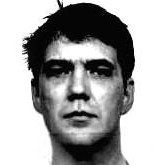
| | | | | Classification: Murderer | | Characteristics: To avoid arrest | | Number of victims: 1 | | Date of murder: November 11, 1985 | | Date of arrest: Same day | | Date of birth: June 17, 1953 | | Victim profile: James D. Mitchell Jr., 42 (Amarillo police officer) | | Method of murder: Shooting (9 mm semi-automatic pistol) | | Location: Randall County, Texas, USA | | Status: Executed by lethal injection in Texas on January 31, 2002 | | | | |
| | | | | 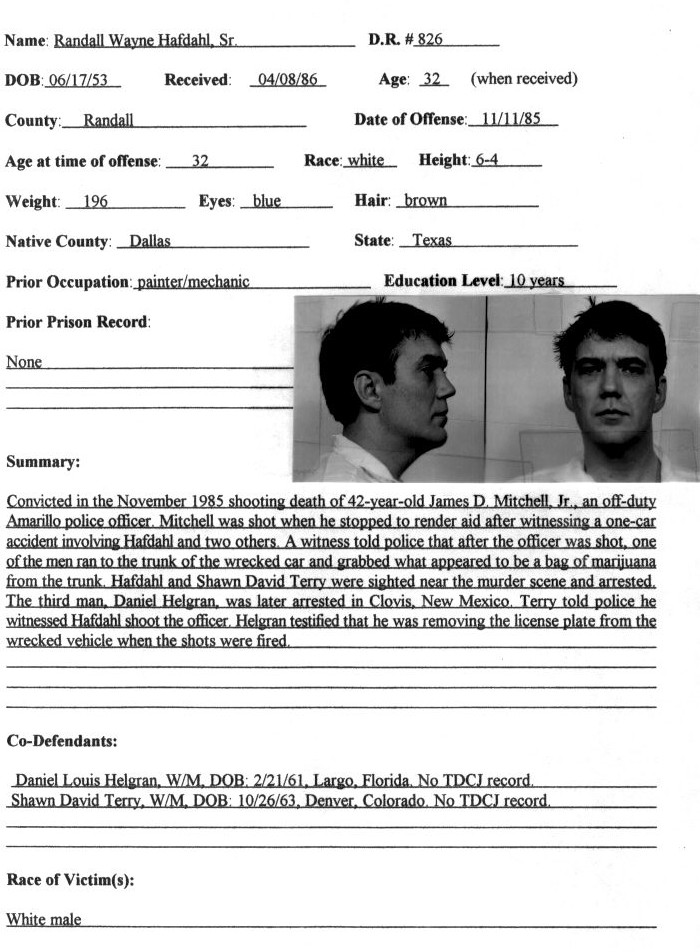
Summary:
James D. Mitchell Jr., 42, an Amarillo police officer, had just finished his shift and was driving home, still in uniform. Mitchell saw Hafdahl's car swerve around his truck and watched as it veered off the road. He stopped to investigate. When he saw Hafdahl running away, he ordered him to stop. With his revolver drawn, Mitchell pursued Hafdahl through the yard until Hafdahl was stopped by a locked gate. Hafdahl then turned and killed Mitchell at close range with four shots from his 9 mm semi-automatic pistol. Mitchell never returned fire. After shooting Mitchell, Hafdahl fled the scene, only to turn himself in later that night. Shawn David Terry, 22, was arrested near the scene of the shooting. Daniel Louis Helgan, 24, was arrested later in New Mexico. Dr. Ralph Erdmann, a forensic pathologist, reconstructed the crime scene at trial and testified that based on the distance and angle from which each shot was fired, only one shot (the one in Mitchell's wrist) could have been fired when Mitchell was standing. Daniel Helgran received a sentence of one year's probation for failure to stop and render aid. After Hafdahl's trial, Dr. Ralph Erdmann pleaded guilty to perjury and tampering with government records in other cases he testified in. Final Meal: A Chef salad with ranch dressing, double meat cheese burger (all the way), French fries, ketchup, and a chocolate shake. Final Words: "All I want to say, I love you. Approximately 28 years ago, I remember looking down at a bassinet. I saw an angel. I am looking at her right now. I love you Colleen. Let's get going. The road goes on forever and the party never ends. Let's rock and roll. Let's go Warden. Me and you, all of us. Remember Wet Willie. Keep on smiling, keep smiling. I love you. It's on the way, I can feel it. It's OK baby, we have a party to go to." Hafdahl's eyes began to close and he seemed to snore. He then took about six deep breaths and closed his eyes. ClarkProsecutor.org
Texas Attorney General Media Advisory Monday, January 30, 2002 Randall Wayne Hafdahl Scheduled to be Executed. AUSTIN - Texas Attorney General John Cornyn offers the following information on Randall Wayne Hafdahl, who is scheduled to be executed after 6 p.m. on Thursday, Jan. 31, 2002. On April 5, 1986, Randall Wayne Hafdahl was sentenced to death for the capital murder of peace officer James Delbert Mitchell, Jr., during the lawful discharge of his duties, in Amarillo, Texas, on November 11, 1985. A summary of the evidence presented at trial follows: FACTS OF THE CRIME Shortly after 4:00 p.m. on November 11, 1985, Amarillo Police Sergeant James Mitchell was driving home from work when he witnessed an accident. Randall Hafdahl, who was driving across Texas with two friends, Shawn Terry and Daniel Helgren, was driving recklessly and lost control of his car. Hafdahl's car left the highway, crossed a frontage road, crashed through a wooden fence, and came to rest in the back yard of a private residence. Although he was off-duty, Officer Mitchell--who was still dressed in his police uniform and wearing an unzipped windbreaker with "Amarillo City Police" and a badge insignia emblazoned on it-- stopped to render assistance. Hafdahl, who admitted that he had consumed alcohol and hallucinogenic mushrooms earlier in the day, unsuccessfully tried to restart the car. Hafdahl then exited the car and hid a loaded 9 mm pistol under a jacket he was carrying and attempted to flee through a gate. Hafdahl admitted that he first saw Officer Mitchell as he entered the yard through the downed fence. The evidence shows that Hafdahl turned from Mitchell and tried to escape through a gate which he could not unlatch. Mitchell, who had drawn his gun, pursued Hafdahl through the yard. According to one eyewitness, Mitchell identified himself as a police officer and ordered Hafdahl to stop. When Mitchell was approximately six feet away from Hafdahl, Hafdahl turned and fired four shots, hitting Mitchell each time. Two of the four wounds were mandatorily fatal, perforating Mitchell's heart and lung. Mitchell never returned fire. Hafdahl testified at trial that he was not trying to flee but, rather, trying to hide the gun. He knew the police would arrive shortly and would discover that he was a convicted felon in Texas who had stopped reporting to his probation officer. Hafdahl also testified that although he intentionally shot Officer Mitchell, he was acting in self-defense and did not realize Mitchell was a police officer. Hafdahl believed Mitchell was "an angry motorist" whom Hafdahl had run off the road. Hafdahl blames this misperception on the drugs and alcohol, as well as the rapidity with which the accident and the shooting occurred. At least nine eyewitnesses to the events immediately before and after Officer Mitchell's murder testified that the backyard was visible from the highway, and they could tell Officer Mitchell was a uniformed police officer. The two passengers in Hafdahl's car were also able to identify Mitchell as a police officer. One passenger stated that he knew without a doubt that Mitchell was an officer the second he saw him. "[H]e had his blue uniform, and his gun, so I knew he was a police officer, just by looking." At least four of the witnesses, including one of the passengers in Hafdahl's car, saw Hafdahl turn and look at Officer Mitchell before firing. One witness in the yard heard Mitchell identify himself by saying, "Hey halt, halt, stop, police." The evidence established that at least one of the bullets that hit Mitchell was shot at a maximum of six feet and could have been closer. The State presented the testimony of two police officers, one from Rockwall and the other from Grand Prairie, Texas, who testified that they had arrested Hafdahl on a warrant for aggravated kidnapping, but had released him pending investigation by the FBI. Hafdahl was never officially charged by the FBI on these charges; however, the implication from the evidence was that Hafdahl believed he was wanted on these outstanding charges and killed the officer to avoid arrest. Also, one of Hafdahl's companions testified that in the days before the murder, Hafdahl admitted that he had "jumped bond" in Dallas, and had begun using an alias and had dyed his hair. During the punishment phase of trial, the State presented evidence that Hafdahl had been arrested on Aug. 11, 1980, in Richardson, Texas, and charged with unlawful carrying of a weapon and felony theft. The police had been conducting surveillance of Hafdahl's house on suspicion that the occupants were involved in a burglary ring. Hafdahl and another man left the house and got into a van, which the police subsequently stopped for a traffic violation. During the stop, Hafdahl was caught trying to shove a .38-caliber gun under the seat. When the police conducted a search of the house, they discovered stolen property and narcotics. Five law enforcement officers from both Texas and Colorado testified that they knew Hafdahl to have a bad reputation for being peaceful and law abiding, and reputation for being dangerous and violent. During cross examination of one of these officers, defense counsel elicited details of the kidnapping investigation for which Hafdahl was arrested in 1982. Hafdahl was charged with aggravated kidnapping, but he was never indicted. The officer stated that the alleged kidnapping victim was forcibly taken from Grand Prairie, Texas, by Hafdahl and two others, and transported first to Colorado, then Wyoming, and eventually returned to Texas, where she escaped. During that time, the victim claimed she was beaten, gagged and her life threatened. Hafdahl was not named as one of the two men who originally kidnapped her from the parking lot, but the victim's statement listed him as one of nine people who participated in the course of the abduction. While in Colorado, Hafdahl worked at a place called the "Bates Farm." The Bates Farm manufactured methamphetamines and traded stolen guns and illegal weapons. Hafdahl was known as the "right-hand-man" and the "enforcer" for the Bates Farm. He oversaw the entire drug operation, including selling drugs and collecting debts or money for the sale of drugs. Hafdahl was known to carry a weapon on a daily basis. On the night Hafdahl was arrested in Amarillo, he was arrogant, showed no remorse and claimed to not know why he was being arrested. During a search of the wrecked car, the police recovered a gin bottle and beer cans and several pieces of identification with at least three different names. In response, Hafdahl presented several witnesses and family members who testified that they had never seen him do anything violent, even when provoked. However, on cross-examination, one relative admitted she had not seen him in the six or seven years prior to his arrest. Officer Mitchell had been a police officer for 20 years, 16 of which were spent with the Amarillo Police Department. At the time of his death, Officer Mitchell was 43 years old. He is survived by his wife; three children aged, 20, nine, and eight; and a six-month-old grandson. PROCEDURAL HISTORY November 29, 1985 - Hafdahl was indicted in the 181st District Court of Randal County, Texas, for the capital murder of James Mitchell, a peace officer acting in the course of his official duty, on November 11, 1985. April 4, 1986 - A jury found Hafdahl guilty of capital murder. April 5, 1986 - Following a separate punishment hearing, the court assessed Hafdahl's punishment at death. June 13, 1990 - Hafdahl's conviction and sentence were affirmed by the Texas Court of Criminal Appeals. December 17, 1990 - The Texas Court of Criminal Appeals denied rehearing. May 28, 1991 - The United States Supreme Court denied Hafdahl's petition for certiorari review. July 30, 1991 - Hafdahl filed an application for state writ of habeas corpus. June 1, 1994 - Habeas relief denied by the Court of Criminal Appeals in an unpublished order. May 22, 1995 - Hafdahl filed a third state habeas application, denied by Court of Criminal Appeals. May 25, 1995 - Hafdahl filed a petition for federal writ of habeas corpus in the district court. April 22, 1997 - Hafdahl filed an amended petition for writ of habeas corpus. December 17, 1999 - The district court denied habeas corpus relief and all discovery motions. March 14, 2000 - Hafdahl filed a motion for certificate of probable cause, denied by District Court. August 23, 2000 - U.S. Court of Appeals for Fifth Circuit granted certificate of appealability. May 15, 2001 - After briefing and oral argument, the Fifth Circuit denied Hafdahl's requested relief. June 20, 2001 - The Fifth Circuit denied rehearing. September 18, 2001- Hafdahl filed a petition for writ of certiorari in the United States Supreme Court. November 26, 2001- The United States Supreme Court denied Hafdahl's petition for writ of certiorari.
PRIOR CRIMINAL HISTORY Hafdahl was arrested on charges of aggravated kidnapping and spent seven days in jail in Grand Prairie, Texas. Hafdahl was never convicted on these charges. In 1970, Hafdahl was arrested on charges of misdemeanor theft and shoplifting, in Houston, Texas. In 1975, in Tarrant County, Texas, Hafdahl received a probated sentence of 10 years for the delivery of LSD. In 1980, in Richardson, Texas, Hafdahl was arrested for unlawful carrying of a weapon. According to the arresting officer, the charges were dismissed because Hafdahl could not be found.
Randall Wayne Hafdahl Sr. Txexecutions.org Randall Wayne Hafdahl Sr., 48, was executed by lethal injection on 31 January in Huntsville, Texas for the murder of a policeman. In November 1985, a car carrying three men swerved off of a highway and into the back yard of a private residence. The car was driven by Randall Hafdahl, then 32. According to his trial testimony, Hafdahl was drunk and "pretty messed up" from eating hallucinogenic mushrooms. Unable to restart his car, Hafdahl grabbed a pistol and tried to run away. James D. Mitchell Jr., 42, an Amarillo police officer, had just finished his shift and was driving home, still in uniform. Mitchell saw Hafdahl's car swerve around his truck and watched as it veered off the road. He stopped to investigate. When he saw Hafdahl running away, he ordered him to stop. With his revolver drawn, Mitchell pursued Hafdahl through the yard until Hafdahl was stopped by a locked gate. Hafdahl then turned and killed Mitchell at close range with four shots from his 9 mm semi-automatic pistol. Mitchell never returned fire. After shooting Mitchell, Hafdahl fled the scene, only to turn himself in later that night. Shawn David Terry, 22, was arrested near the scene of the shooting. Daniel Louis Helgan, 24, was arrested later in New Mexico. Under Texas law, murder of a police officer in the line of duty is a capital offense, but only if the killer knows that the victim is a police officer. At his trial, Hafdahl admitting shooting Mitchell, but said he did not know he was a policeman. He said that he only tried to leave the yard in the first place in order to get to a telephone to call a wrecker. When he heard a voice behind him, he turned and saw a man with a gun. Fearing for his life, he shot him four times in rapid succession. He said he only realized Mitchell was a policeman as he was falling to the ground. He said that Mitchell was wearing a windbreaker that concealed much of his uniform. The prosecution, however, depicted the killing as one that Hafdahl committed knowingly. They said that Hafdahl's first shot hit Mitchell in the wrist and disarmed him, then he continued to advance on the uniformed officer and pump rounds into him while he was on the ground. The question of whether Hafdahl knew Mitchell was a policeman centered around three questions: 1) Was Mitchell visually identifiable as a policeman? 2) Did Mitchell verbally identify himself as a policeman? 3) Did Hafdahl see or hear Mitchell before shooting him? The prosecution offered substantial evidence that Mitchell was visually identifiable as a policeman. They pointed out that Mitchell's police-issue windbreaker was marked, "Amarillo City Police" and bore a badge insignia. At least eleven witnesses, including Terry and Helgran, testified that they recognized Mitchell as a policeman from his uniform. The prosecution also presented witnesses who testified that they heard Mitchell yell, "stop, police!" and similar warnings. The most hotly disputed question, therefore, was whether Hafdahl saw or heard Mitchell before shooting him. Mitchell himself testified that his senses were numbed from the drugs and alcohol in his system. He heard someone yelling at him, but he couldn't understand, and wasn't even sure whether the man yelling at him was the same man who was chasing him, or one of his companions. Shawn Terry testified that he saw Hafdahl shoot Mitchell four times in rapid succession. Daniel Helgran testified that he was removing the license plate from the wrecked vehicle when the shots were fired. He also said in a sworn statement that the shots were fired in rapid succession. The prosecution, however, used the testimony of Dr. Ralph Erdmann, a forensic pathologist, to reconstruct the crime. Erdmann testified that based on the distance and angle from which each shot was fired, only one shot -- the one in Mitchell's wrist -- could have been fired when Mitchell was standing. The other three, including the two fatal ones through the heart, were fired when Mitchell was already down. In addition, the prosecution brought four witnesses who said that they saw Hafdahl turn and look at Mitchell before shooting him. Hafdahl had a previous conviction for delivery of LSD. He received a sentence of ten years' probation. Testimony at the punishment phase of his trial indicated that Hafdahl had previously overseen a methamphetamine production operation in Colorado. He had also been charged with aggravated kidnapping and had a warrant out for his arrest at the time of Mitchell's killing. He had dyed his hair and began using the aliases Robert Moore and Jack Douglas Cone. Prosecutors said that Hafdahl knew that if he was caught by Mitchell, he would be arrested and tried for kidnapping. A jury convicted Hafdahl of capital murder in April 1986 and sentenced him to death. The Texas Court of Criminal Appeals affirmed his conviction and sentence in June 1990. He was originally scheduled to be executed in July 1995, but received a stay. Four the next 4½ years, Hafdahl won various motions to keep his case open. In August 2000, the U.S. Fifth Circuit Court of Appeals agreed to hear his case. After briefing and oral argument, the Fifth Circuit denied his appeal in May 2001. Hafdahl did not win any proceedings in state or federal court after that. Daniel Helgran received a sentence of one year's probation for failure to stop and render aid. After Hafdahl's trial, Dr. Ralph Erdmann pleaded guilty to perjury and tampering with government records in other cases he testified in. In an interview on death row, Hafdahl retold his account of the shooting. "I believed him to be a driver who was coming at me angry because I hit him with my car," he said. In another interview, he said,"I started to turn around, and I saw someone standing at the other end of the fence, but I couldn't hardly see him. ... There was a gun, I could see that real clear." Mitchell didn't say anything, Hafdahl said. "Now, I been shaken down by police officers plenty of times in my life, and they ever do something like that, they always tell me, 'Put your hands on your head. Get on the ground.' - something," Hafdahl said. "They don't just run up on you. And when he ran up on me ... I just spun around and clipped him down. It was just Pow! Pow! Pow! Pow! And as he's falling, and he's going to the ground, I realized right then who he was." Hafdahl said he felt remorse for the killing since the night it happened. "I wish I could give the Mitchells back what they lost. I wish I could give Mitchell back what he lost, but I can't," he said. At his execution, Hafdahl released a written last statement that criticized the law enforcement and prosecution officials involved in his case, by name. He accused them of planting evidence and lying at his trial in order to secure his conviction. The next part of his statement read, "And to the Mitchell family: I truely am sorry for the tragedy that took place on Nov 11, 85. Thats all I can give you. Thats all I will give you. Because today your making my family and loved ones a victim just as you have cried to the world you were in this tragedy. I did not deliberately shoot James Mitchell. I had no premeditation in my thoughts when I spun around and fired, no matter how many fantasy motives Clayton and Sherrod fabricated. So today my family becomes a victim. You know, the truth sets you free, and the truth is, if your loved one had acted with any professionalism at all, he would be alive today! And thats all I got to say about it." Hafdahl also made an oral last statement, in which he expressed affection for his daughter. After telling her and other friends that he loved them, he lifted his head from the death chamber gurney and shouted into the microphone, "The road goes on forever and the party never ends." He screamed, his faced turning crimson. "Rock 'n Roll!" he shouted. After this, he regained his composure and the lethal injection was begun. "It's on the way. I can feel it. Take me home. We got a party to go to," Hafdahl said. His voice rose again and he shouted "Remember Wet Willie. Keep on smiling. Keep on smiling." His eyes closed and he began to snore. He took about eight breaths and then stopped. Eleven minutes later, he was pronounced dead at 6:48 p.m.
ProDeathPenalty.com The defendant showed no remorse as 47th District Judge David Gleason scheduled his lethal injection for murdering an Amarillo police officer. After Gleason set Jan. 31 as the execution date, Randal Wayne Hafdahl said, "Sounds good to me." "That reveals his demeanor and attitude from the beginning," Randall County Criminal District Attorney James Farren said. "He's showed complete disdain." Jurors sentenced Hafdahl to death April 7, 1986, for murdering Amarillo Police Department Sgt. James Mitchell who was 42 at the time of his death in 1985. Shortly after 4:00 p.m. on November 11, 1985, Randal Wayne Hafdahl shot and killed Sergeant James D. Mitchell, Jr., of the Amarillo, Texas police department. Hafdahl had been driving across Texas with two friends. Hafdahl, who admits that he had been consuming alcohol and hallucinogenic mushrooms earlier in the day, was driving recklessly and lost control of his car. The car left the highway, crossed a frontage road, crashed through a wooden fence around a private residence, and eventually came to rest in the backyard. When the car would not start, Hafdahl took a loaded 9mm pistol from the glove box, hid it under his coat, and attempted to flee. He testified that he wanted to hide the gun because he knew the police would arrive soon and discover that he was a convicted felon (for possession of a controlled substance) who had stopped reporting to his probation officer. Sergeant Mitchell was driving home from work when he witnessed the accident. He was still dressed in his police uniform and was wearing an unzipped windbreaker with "Amarillo City Police" and a badge insignia emblazoned on it. Hafdahl testified that he first saw Mitchell when the officer entered the backyard through the downed fence. At that point, Hafdahl turned from Mitchell and tried to escape through a gate, which he could not unlatch. Mitchell pursued Hafdahl across the yard and, according to one eyewitness, identified himself as a policeman and ordered Hafdahl to stop. Mitchell apparently had his police revolver drawn, although he never fired a shot. When Mitchell had almost caught up with him, Hafdahl turned and shot Mitchell four times from approximately six feet away. Hafdahl was then indicted for the capital offense of murdering a police officer. The critical issue at trial was whether Hafdahl knew that Mitchell was an officer. Hafdahl testified that he believed Mitchell was an angry motorist whom Hafdahl had run off the road. Hafdahl contends that, because he was under the influence of drugs and the events took place so quickly, he did not realize Mitchell was a police officer until after he had fired the fatal shots. As the district court observed, however, the State put on extensive evidence that Hafdahl must have known that Mitchell was an officer. First, a worker who was only 20 to 25 feet from the crime scene, testified that Mitchell identified himself as a police officer as he approached Hafdahl. Numerous witnesses testified that Mitchell was gesturing and yelling at Hafdahl but that they were too far away to hear what he was saying. When asked whether Mitchell had ever identified himself as an officer, Hafdahl replied, "I can't say if he did or he didn't. All I can say is I didn't hear him." Second, twelve witnesses, most of whom had stopped on the highway, testified that they immediately recognized Mitchell as a police officer because of his uniform. One of Hafdahl's traveling companions, who was still in the car when Mitchell entered the yard, testified that Mitchell's police uniform was plainly visible and he knew Mitchell was an officer " the second I saw him. . . . No doubt in my mind." As noted above, Hafdahl admits that he saw Mitchell when he entered the backyard through the downed fence. The State argued that Hafdahl would have noticed the police uniform and the Amarillo City Police windbreaker. Third, Hafdahl shot Mitchell at close range and could not have failed to notice Mitchell's uniform. Although the estimates varied somewhat, two ballistics experts from the Federal Bureau of Investigation testified that Hafdahl was no more than six feet from Mitchell when he fired the shots, and one of Hafdahl's companions testified that Hafdahl was approximately three to five feet from Mitchell. Even if one assumed that Hafdahl had not noticed Mitchell's uniform when he entered the yard, the State suggested, Hafdahl surely would have seen the uniform before firing the fatal shots from such close range. To further establish that Hafdahl was close enough to know that Mitchell was an officer, the State called, among others, Ralph Erdmann, a forensic pathologist. The crux of Erdmann's testimony was that (1) Hafdahl shot Mitchell four times with a semiautomatic 9mm pistol; (2) the first two shots were non-fatal wounds to the abdomen and arm; (3) Hafdahl moved closer to Mitchell while firing, although it was not clear how quickly the shots were fired; (4) both the third and fourth shots to the chest were mandatorily fatal; and (5) judging from the gunpowder stippling specks on Mitchell's face, Hafdahl was approximately two and a half feet from Mitchell when the final shot was fired. Erdmann explained to the jury that many of the assumptions underlying his conclusions were drawn from the reports and conclusions of the investigating officers. His testimony often indicated that the autopsy results were "consistent" with the officers' theories. To support its argument that Hafdahl intentionally killed Mitchell, the State put on evidence that Hafdahl had a motive to avoid apprehension. Two Texas officers (one from Rockwall, the other from Grand Prairie) testified that they had arrested Hafdahl on a warrant for aggravated kidnapping and turned the case over to the FBI. During the guilt phase, neither officer testified about the details of the alleged kidnapping. Neither officer purported to know how the FBI had resolved the case. The implication was that Hafdahl might have believed he was a wanted man and, consequently, that he killed Mitchell in order to evade capture. The jury convicted Hafdahl of capital murder on April 4, 1986. During the sentencing phase, the State requested the death penalty and introduced additional evidence as to the three required "special issues": (1) Whether Hafdahl deliberately killed Mitchell; (2) whether Hafdahl's response to Mitchell's provocation, if any, was unreasonable; and (3) whether Hafdahl would probably commit criminal acts of violence in the future. Erdmann was not called to testify further, but the police officers testified in more detail about the kidnapping arrest. The jury then sentenced Hafdahl to death on April 7, 1986. The execution date being set followed the end of 16 years of appeals. A 10-man team of Randall County Sheriff's deputies and bailiffs guarded the courtroom. The entire Justice Building in Canyon also was under heavy security provided by deputies and Canyon police officers. Hafdahl, 48, wore shackles on his ankles, and his wrists were locked to a chain around his waist when Sheriff Joel Richardson brought him into the courtroom. Mitchell suffered multiple gunshot wounds Nov. 11, 1985, when he was returning home from work and stopped to investigate a traffic accident involving a car that skidded off the interstate and into the back yard of a residence. "The first shot struck Sgt. Mitchell's wrist and disarmed him, he was helpless," Farren said. "Hafdahl continued to approach and executed him. He continued to pump rounds into Sgt. Mitchell. If he is willing to kill a police officer, he certainly is not afraid of you or me." The three occupants of the wrecked car were fleeing the scene when Hafdahl was stopped by a fence gate that would not open. According to trial testimony, Mitchell, who was wearing his uniform, ordered Hafdahl to stop. Under questioning from one of his defense attorneys, Hafdahl testified at his trial that he was "pretty messed up" on hallucinogenic mushrooms and gin the afternoon he killed Mitchell. He admitted shooting the officer with a 9mm semi-automatic pistol but said he did not know Mitchell was a policeman. "I heard somebody coming up behind me, and I just spun around and started firing," Hafdahl said. Five officers from Texas and Colorado, testifying for the state, told the court they knew Hafdahl to be a difficult individual to deal with. During cross-examination by the defense, 1 of these officers told the court about a 1982 kidnapping incident in which Hafdahl was charged. He was never indicted for the kidnapping. The officer said the alleged kidnapping victim was taken forcefully by Hafdahl and two accomplices from Grand Prairie to Colorado and then transported to Wyoming. She eventually escaped and told police she had been beaten, gagged and had her life threatened. Colorado police reports said while there, Hafdahl worked as an enforcer at a methamphetamine operation known as Bates Farm. The report said Hafdahl oversaw the entire drug operation and he was known to carry a weapon at the farm on a daily basis. Ken Farren, chief deputy in the Potter County Sheriff's Department, worked for about 12 years with Mitchell and attended Friday's hearing. "Hafdahl said in the courtroom it was fine with him, and today is fine with us," Ken Farren said. "Jim was somebody I could lean on. It's time for justice to be served." The widow and daughters of slain policeman James Mitchell came to Canyon to see a judge set the execution date for the killer of their husband and father. "After 16 years it's about time. We have been through it every step of the way, and I'm looking forward to reaching a conclusion. It has taken a toll on my family," said Ellen Mitchell Stone, the widow of Amarillo Police Department Sgt. James Mitchell. "My girls were 8 and 9 when their father was killed. Now, they have graduated from college, are married and have jobs." State and federal appeals kept the case from reaching a resolution. Jurors sentenced Randal Hafdahl, now 48, to death April 7, 1986, for murdering Mitchell, who was 42 at the time of his death in 1985. At the hearing, Judge David Gleason set Jan. 31 as the date an executioner will give Hafdahl his lethal injection. "It's a shame their whole lives have been exposed to this bureaucracy. There was never any doubt he did it. He admitted it on the stand," Ellen Mitchell Stone said. "It just let his attorney manipulate the system with reams and reams of motions. It is time it came to an end."
National Coalition to Abolish the Death Penalty Randall Hafdahl - Scheduled Execution Date and Time: 1/31/02 7:00 PM EST. Randall Hafdahl is scheduled to be the third person executed in Texas this year. Hafdahl was convicted of shooting off-duty police officer James Mitchell, who was investigating a traffic accident involving Hafdahl. Texas already has scheduled six executions between Jan. 9 and the first week of March. Hafdahl’s case prompted some members of the Texas Court of Criminal Appeals to oppose his death sentence, citing inappropriate and prejudicial evidence presented at trial. Judge Teague noted in his dissent, “I must find that the trial judge clearly erred in admitting into evidence testimony that went to the extraneous offense of aggravated kidnapping.” This comment refers to the admission of evidence during trial that linked Hafdahl- unindicted and not under suspicion – to an FBI investigation of an unrelated kidnapping charge that was three years old. Judge Teague argued that this was inherently prejudicial and he urged that Hafdahl’s sentence be vacated and a new trial ordered. Clearly, Hafdahl’s constitutional rights were suspended by the State of Texas. The Texas Court of Criminal Appeals split 3-2 on the decision in Hafdahl’s case. Let the State of Texas know that sending a person to death on the vote of one judge violates human rights and threatens the constitutional rights of us all.
Randall Wayne Hafdahl Canyon News By Karla Abernathy Thetford - Canyon News staff. "Sounds good to me," was Randall Wayne Hafdahl's response when he was told when his life would end. Hafdahl, also known as Jack Douglas Cone, was sentenced to die by lethal injection on Jan. 31, 2002 at 6 p.m. Hafdahl remained calm during the hearing Friday, showing little emotion as presiding judge David Gleason set the execution date. Hafdahl was found guilty of capital murder by a Randall County jury on April 7, 1986, and sentenced to death for the 1985 murder of Amarillo police officer Sgt. James Mitchell. On the night of Nov. 11, 1985, Mitchell approached a vehicle that had skidded off of the road. As he approached the vehicle, he was shot in the hand leaving him powerless, according to Ken Farren, an APD officer at the time of the shooting. Hafdahl opened fire again killing the officer. Farren said he was in the office when he got the call that an officer was down. At that moment a search was launched with the help of surrounding police departments to find the killer. After approximately eight hours Hafdahl and one of his accomplices were in custody. A third suspect was captured a short time later. Hafdahl has continued to appeal the court's decision over the last 16 years, but officials now believe he has run out of options. "Mr. Hafdahl's death is the only appropriate verdict in this case," District Attorney James Farren said. "I think he is finally out of options and on Jan. 31 justice will finally be done." That day will help to bring closure for Ken Farren and Mitchell's family. "The family has had 16 years of suffering…After 16 years, it is time for this to be over," Ken Farren said. Mitchell's wife and two daughters were present at the hearing, and did not wish to speak to the media. Ken Farren added that this was another bittersweet reminder of the danger law enforcement officials place themselves in everyday. "He (Mitchell) was dedicated to protect and serve the community," Farren said. "James Mitchell sacrificed everything. He died out there. Officers put their lives on the line everyday." Hafdahl was taken back to Huntsville where he will await his execution date.
Execution Date Set for Hafdahl Jan. 31 'sounds good to me,' killer of police officer says By Kevin Welch - Amarillo Globe News Online Saturday, December 15, 2001 The defendant showed no remorse Friday as 47th District Judge David Gleason scheduled his lethal injection for murdering an Amarillo police officer. After Gleason set Jan. 31 as the execution date, Randal Wayne Hafdahl said, "Sounds good to me." "That reveals his demeanor and attitude from the beginning," Randall County Criminal District Attorney James Farren said. "He's showed complete disdain." Jurors sentenced Hafdahl to death April 7, 1986, for murdering Amarillo Police Department Sgt. James Mitchell who was 42 at the time of his death in 1985. Friday's hearing followed the end of 16 years of appeals. A 10-man team of Randall County Sheriff's deputies and bailiffs guarded the courtroom. The entire Justice Building in Canyon also was under heavy security provided by deputies and Canyon police officers. Hafdahl, 48, wore shackles on his ankles, and his wrists were locked to a chain around his waist when Sheriff Joel Richardson brought him into the courtroom. Mitchell suffered multiple gunshot wounds Nov. 11, 1985, when he was returning home from work and stopped to investigate a traffic accident involving a car that skidded off Interstate 27 and into the back yard of a residence in the 3600 block of South Austin Street. "The first shot struck Sgt. Mitchell's wrist and disarmed him, he was helpless," Farren said. "Hafdahl continued to approach and executed him. He continued to pump rounds into Sgt. Mitchell. If he is willing to kill a police officer, he certainly is not afraid of you or me." The three occupants of the wrecked car were fleeing the scene when Hafdahl was stopped by a fence gate that would not open. According to trial testimony, Mitchell, who was wearing his uniform, ordered Hafdahl to stop. Under questioning from one of his defense attorneys, Hafdahl testified at his trial that he was "pretty messed up" on hallucinogenic mushrooms and gin the afternoon he killed Mitchell. He admitted shooting the officer with a 9mm semi-automatic pistol but said he did not know Mitchell was a policeman. "I heard somebody coming up behind me, and I just spun around and started firing," Hafdahl said. Ken Farren, chief deputy in the Potter County Sheriff's Department, worked for about 12 years with Mitchell and attended Friday's hearing. "He (Hafdahl) said in the courtroom it was fine with him, and today is fine with us," Ken Farren said. "He (Mitchell) was somebody I could lean on. It's time for justice to be served."
Abolish Archives Death-row inmate Randal Wayne Hafdahl asked a federal judge Monday to change her ruling rejecting Hafdahl's death-penalty appeal in the 1985 shooting death of Amarillo Police Sgt. James D. Mitchell. Thomas G. Mattson, one of Hafdahl's attorneys, filed a motion to alter or change U.S. District Judge Mary Lou Robinson's final judgment in the case. The motion also seeks to reopen the judgment and expand the court record. The motion resurrects an earlier defense claim that then-Randall County Criminal District Attorney Randy Sherrod allowed discredited forensic pathologist Ralph Erdmann to present false testimony during Hafdahl's trial. Erdmann was the main forensic pathologist for West Texas in the 1980s, handling bodies for 48 counties. Erdmann pleaded no contest in 1994 to 6 felonies tied to falsified evidence and botched autopsies in 3 counties. He surrendered his medical license and was sentenced to 10 years of probation, according to the Associated Press. Among other claims, Hafdahl's defense contends state prosecutors knowingly used false testimony from another witness and that Judge Robinson's rulings on various aspects of the case were incorrect. In a ruling last month, Robinson granted a motion by the state of Texas for summary judgment and rejected a petition by Hafdahl for a writ of habeas corpus. A habeas corpus writ orders a person in custody to be brought before a court. It places the burden of proof on those detaining the person to justify the imprisonment. Hafdahl, 46, was sentenced to death April 7, 1986, after Randall County jurors found him guilty of capital murder in Mitchell's death. Mitchell, 43, was shot Nov. 11, 1985, as he approached a car that skidded off the highway near a residence. As the off-duty officer approached the car, Hafdahl and 2 other men got out of the car, and Mitchell ordered them to stop, according to court records. Robinson's ruling states there is little doubt Hafdahl, a convicted felon wanted for a probation violation, killed Mitchell by shooting him at the scene. "There is no dispute that Hafdahl shot Mitchell 4 times or that those shots were the cause of Sergeant Mitchell's death," the ruling states. "At trial, Hafdahl contended that he acted in self-defense because he did not recognize that Mitchell was a police officer and believed that he was an irate motorist." The Texas Court of Criminal Appeals has rejected earlier appeals filed by Hafdahl in the case, but Robinson granted Hafdahl a stay of execution in 1995 to review a lengthy appellate petition filed by his attorneys. The judge's recent ruling reviewed 84 points of alleged constitutional error raised by Hafdahl's attorneys. In November, Mitchell's wife, Ellen Mitchell Stone, and other family members complained about delays in Hafdahl's execution during a brief protest at Amarillo's federal courthouse. Earlier, she said her 2 daughters - then 8 and 9 at the time of the slaying - want Hafdahl executed before they have families of their own. "That was their father that was killed. Now, they are young women, married and are graduating from college this year," she said. "We just want an end to it." (source: Amarillo Globe-News)
Hafdahl Executed for 1985 Slaying By Dan Bell - The Huntsville Item Online January 31, 2002 A convicted cop killer, executed Thursday night at the Huntsville "Walls" Unit, took his last breath swearing he acted in self-defense for the shooting death of an Amarillo police officer. Dallas County native Randall Hafdahl, 48, was put to death for the Nov. 11, 1985, slaying of 20-year law enforcement officer James Mitchell, 43, a husband and father of three. Hafdahl was the fourth inmate executed by Texas this year. At 6:02 p.m. Thursday, Hafdahl was led from his holding cell and strapped to a stainless steel gurney. The execution was delayed until the attending physician was able to locate a suitable vein to insert the needle from which the lethal solution of drugs would flow. Hafdahl chose to ignore the victim's family and friends. Instead, he opted to spend his last minutes focusing on those closest to him. "All I want to say, I love you," Hafdahl said, tearing up while looking at his daughter, Colleen Shepherd. "Approximately 28 years ago, I remember looking down at a bassinet. I saw an angel. I am looking at her right now. I love you Colleen." With his face turning a bright crimson color, Hafdahl continued in a loud voice. "Let's get going. The road goes on forever and the party never ends," he said, referring to a song by Texas musician Robert Earl Keen. "Let's rock and roll," he thundered into the microphone dangling just above his head. "Let's go Warden. Me and you, all of us. "Remember Wet Willie," said Hafdahl, possibly referring to the Southern rock band of the same name. "Keep on smiling, keep smiling. I love you. "It's on the way, I can feel it," Hafdahl said of the lethal drugs entering his body. "It's OK baby, we have a party to go to." Hafdahl's eyes began to close and he seemed to snore. He then took about six deep breaths and closed his eyes. Hafdahl was pronounced dead at 6:48 p.m. According to court testimony, Hafdahl was driving drunk and on drugs on the night of the murder, and he was accompanied by two men, Shawn Terry and Daniel Helgren. Hafdahl lost control of his vehicle, crashing through a wood fence before coming to rest in the backyard of a private residence. Mitchell, who was off-duty, was still dressed in his police uniform when he stopped his personal vehicle at the accident scene to offer assistance. Seeing the approaching officer, Hafdahl, with a loaded 9 mm pistol hidden beneath his jacket, attempted to flee through a locked gate. The officer drew his gun and identified himself to Hafdahl as a member of the local police department. When Mitchell was about six feet from the suspect, Hafdahl turned and fired his pistol four times. Two of the shots hit Mitchell in the heart and lung area, killing him instantly. In a Wednesday death row interview, Hafdahl said the incident was "a tragic incident." "I wish it would have never happened but the fault lies in both of us," Hafdahl said. "If the cop had done his job right this (killing) would have never happened." After Thursday's execution, the husband of Mitchell's daughter, Dean Clapper, read from a prepared statement. "Tonight's execution can not begin to erase the years of heartache, grief and emotional loss that Hafdahl's actions have caused our family," Clapper said. "Never to be regained is the innocence of two children, the loss of childhood memories or recover the loss of a loving husband and father. "In conclusion, our family has stood together facing the most evil of individuals. Tonight, we have finally obtained peace."
IN THE UNITED STATES COURT OF APPEALS
FOR THE FIFTH CIRCUIT No. 00-10268
RANDAL WAYNE HAFDAHL, Petitioner-Appellant,
v.
GARY L. JOHNSON, Director, Texas Department of Criminal Justice,
Institutional Division, Respondent-Appellee. Appeal from the United States District Court for the Northern District of Texas May 15, 2001 Before JOLLY, JONES, and BENAVIDES, Circuit Judges. E. GRADY JOLLY, Circuit Judge: In 1986, Randal Wayne Hafdahl was convicted of murder in a Texas state court and sentenced to death for killing a police officer. The conviction and sentence were affirmed on appeal. Hafdahl now seeks federal habeas corpus relief. He contends that his constitutional rights were violated, both in the guilt phase and the punishment phase of his state trial, when the prosecutor knowingly used false testimony of a forensic pathologist and when the state court admitted testimony relating to a prior unadjudicated kidnaping offense. The district court denied his habeas petition. We granted a Certificate of Appealability ("COA") and now affirm the district court's judgment. IA Shortly after 4:00 p.m. on November 11, 1985, Randal Wayne Hafdahl shot and killed Sergeant James D. Mitchell, Jr., of the Amarillo, Texas police department. Hafdahl had been driving across Texas with two friends, Shawn Terry and Daniel Helgren. Hafdahl, who admits that he had been consuming alcohol and hallucinogenic mushrooms earlier in the day, was driving recklessly and lost control of his car. The car left the highway, crossed a frontage road, crashed through a wooden fence around a private residence, and eventually came to rest in the backyard. When the car would not start, Hafdahl took a loaded 9mm pistol from the glove box, hid it under his coat, and attempted to flee. He testified that he wanted to hide the gun because he knew the police would arrive soon and discover that he was a convicted felon (for possession of a controlled substance) who had stopped reporting to his probation officer. Sergeant Mitchell was driving home from work when he witnessed the accident. He was still dressed in his police uniform and was wearing an unzipped windbreaker with "Amarillo City Police" and a badge insignia emblazoned on it. Hafdahl testified that he first saw Mitchell when the officer entered the backyard through the downed fence. At that point, Hafdahl turned from Mitchell and tried to escape through a gate, which he could not unlatch. Mitchell pursued Hafdahl across the yard and, according to one eyewitness, identified himself as a policeman and ordered Hafdahl to stop. Mitchell apparently had his police revolver drawn, although he never fired a shot. When Mitchell had almost caught up with him, Hafdahl turned and shot Mitchell four times from approximately six feet away. BHafdahl was then indicted for the capital offense of murdering a police officer. Texas law provides that a person commits the offense of capital murder of a peace officer if (1) that person knows that the victim is a peace officer, (2) he intentionally murders the peace officer, and (3) the peace officer is then acting in the lawful discharge of an official duty, such as investigating a traffic accident. See Tex. Penal Code Ann. � 19.03(a)(1). The critical issue at trial was whether Hafdahl knew that Mitchell was an officer. Hafdahl testified that he believed Mitchell was an angry motorist whom Hafdahl had run off the road. Hafdahl contends that, because he was under the influence of drugs and the events took place so quickly, he did not realize Mitchell was a police officer until after he had fired the fatal shots. As the district court observed, however, the State put on extensive evidence that Hafdahl must have known that Mitchell was an officer. First, a worker who was only 20 to 25 feet from the crime scene, testified that Mitchell identified himself as a police officer as he approached Hafdahl. Numerous witnesses testified that Mitchell was gesturing and yelling at Hafdahl but that they were too far away to hear what he was saying. When asked whether Mitchell had ever identified himself as an officer, Hafdahl replied, "I can't say if he did or he didn't. All I can say is I didn't hear him." Second, twelve witnesses, most of whom had stopped on the highway, testified that they immediately recognized Mitchell as a police officer because of his uniform. One of Hafdahl's traveling companions, who was still in the car when Mitchell entered the yard, testified that Mitchell's police uniform was plainly visible and he knew Mitchell was an officer "the second I saw him. . . . No doubt in my mind." As noted above, Hafdahl admits that he saw Mitchell when he entered the backyard through the downed fence. The State argued that Hafdahl would have noticed the police uniform and the Amarillo City Police windbreaker. Third, Hafdahl shot Mitchell at close range and could not have failed to notice Mitchell's uniform. Although the estimates varied somewhat, two ballistics experts from the Federal Bureau of Investigation testified that Hafdahl was no more than six feet from Mitchell when he fired the shots, and one of Hafdahl's companions testified that Hafdahl was approximately three to five feet from Mitchell. Even if one assumed that Hafdahl had not noticed Mitchell's uniform when he entered the yard, the State suggested, Hafdahl surely would have seen the uniform before firing the fatal shots from such close range. CTo further establish that Hafdahl was close enough to know that Mitchell was an officer, the State called, among others, Ralph Erdmann, a forensic pathologist. The crux of Erdmann's testimony was that (1) Hafdahl shot Mitchell four times with a semiautomatic 9mm pistol; (2) the first two shots were non-fatal wounds to the abdomen and arm; (3) Hafdahl moved closer to Mitchell while firing, although it was not clear how quickly the shots were fired; (4) both the third and fourth shots to the chest were mandatorily fatal; and (5) judging from the gunpowder stippling specks on Mitchell's face, Hafdahl was approximately two and a half feet from Mitchell when the final shot was fired. Erdmann explained to the jury that many of the assumptions underlying his conclusions were drawn from the reports and conclusions of the investigating officers. His testimony often indicated that the autopsy results were "consistent" with the officers' theories. To support its argument that Hafdahl intentionally killed Mitchell, the State put on evidence that Hafdahl had a motive to avoid apprehension. Two Texas officers (one from Rockwall, the other from Grand Prairie) testified that they had arrested Hafdahl on a warrant for aggravated kidnaping and turned the case over to the FBI. During the guilt phase, neither officer testified about the details of the alleged kidnaping. Neither officer purported to know how the FBI had resolved the case. The implication was that Hafdahl might have believed he was a wanted man and, consequently, that he killed Mitchell in order to evade capture.(1)
DThe jury convicted Hafdahl of capital murder on April 4, 1986. During the sentencing phase, the State requested the death penalty and introduced additional evidence as to the three required "special issues": (1) Whether Hafdahl deliberately killed Mitchell; (2) whether Hafdahl's response to Mitchell's provocation, if any, was unreasonable; and (3) whether Hafdahl would probably commit criminal acts of violence in the future. Erdmann was not called to testify further, but the police officers testified in more detail about the kidnaping arrest. The jury then sentenced Hafdahl to death on April 7, 1986. EThe Texas Court of Criminal Appeals affirmed his conviction in 1990. See Hafdahl v. State, 805 S.W.2d 396 (Tex. Ct. Crim. App. 1990)(en banc), cert. denied, 500 U.S. 948, 111 S.Ct. 2250, 114 L.Ed.2d 491 (1991). Hafdahl instituted state habeas proceedings in 1991, but the Texas Court of Criminal Appeals ultimately denied relief in 1995. In May 1995, prior to the effective date of the Antiterrorism and Effective Death Penalty Act, Hafdahl filed a petition for a writ of habeas corpus in the United States District Court for the Northern District of Texas. After limited discovery was had and the petition was amended, the district court thoroughly and carefully considered all eighty-four points of error raised by Hafdahl. The district court concluded that Hafdahl was not entitled to federal habeas relief and denied the petition in December 1999. This court granted a COA on August 23, 2000, to determine whether Hafdahl's rights were violated -- at either the guilt phase of the trial or at sentencing -- because of (1) Dr. Erdmann's allegedly false testimony or (2) the admission of evidence related to a prior unadjudicated kidnaping offense. We now affirm the judgment of the district court. IIHafdahl contends that the State knowingly used false testimony from Dr. Erdmann and thereby denied him due process of law, both at the guilt phase of the trial and at sentencing. AThe Due Process Clause of the Fourteenth Amendment forbids the State knowingly to use, or fail to correct, perjured testimony. See Giglio v. United States, 405 U.S. 150, 153, 92 S.Ct. 763, 766, 31 L.Ed.2d 104 (1972); Napue v. Illinois, 360 U.S. 264, 271, 79 S.Ct. 1173, 1178-79, 3 L.Ed.2d 1217 (1959). To prove that the State has denied him due process of law by relying on perjurious testimony, Hafdahl must prove that (1) a witness for the State testified falsely; (2) the State knew the testimony was false; and (3) such testimony was material. Knox v. Johnson, 224 F.3d 470, 477 (5th Cir. 2000). Whether the prosecutor knowingly used false and material testimony is a mixed question of law and fact, and we therefore review the district court's factual findings for clear error and the conclusions drawn from those facts de novo. Creel v. Johnson, 162 F.3d 385, 391 (5th Cir. 1998). BHafdahl focuses on ten fairly specific statements that Erdmann made at trial. Erdmann testified, to a reasonable medical certainty, that (1) he believed he had determined the sequence of shots; (2) the first shot hit Mitchell's left arm and passed through to his abdomen; (3) the damage to his arm prevented Mitchell from firing his weapon (Mitchell was evidently left-handed); (4) Mitchell's gun was thrown from his left hand to the right side of his body; (5) the second shot was a non-fatal wound to the abdomen; (6) both the third and fourth shots were mandatorily fatal wounds to the chest; (7) Hafdahl moved closer to Mitchell as he fired; (8) Mitchell slumped to the ground as the final shots were fired; (9) the third and fourth shots left gunpowder burns (or "stippling" marks) on Mitchell's face; and (10) test firings of Hafdahl's pistol indicated that the last shot was fired from a distance of two and a half feet. Hafdahl contends that each of these ten statements is false. Hafdahl attempts to prove the falsity of these statements by comparing Erdmann's 1986 trial testimony to his 1996 deposition.(2) According to Hafdahl, Erdmann admitted in 1996 that he could have testified only as to a "possibility" of the sequence of shots; that there was a 30% to 40% probability that Mitchell could have returned fire after being shot in the forearm; that as a forensic pathologist, he could not form an opinion as to whether Hafdahl advanced on Mitchell as he fired or as to how much time elapsed between the shots; and that his opinions as to the gunpowder marks and distance were speculative and unconfirmed.
CHaving carefully reviewed the record, however, we cannot say that Erdmann, in offering his opinion testimony, testified falsely. There are two reasons why Hafdahl's characterization of Erdmann's testimony is not persuasive. (1)First, at the beginning of his 1986 trial testimony, Erdmann explained the basis of his opinion testimony. He testified that he had relied heavily on interviews with the investigating officers, FBI ballistics reports, crime scene photographs, and other second-hand sources of information. It is clear that, in many instances, his testimony was that the autopsy results (such as entry and exit angles of the bullets) were consistent with the officers' theory of what had happened. Hafdahl may be justified in complaining that Erdmann's investigation was not sufficiently independent, but, as this court has pointed out, the proper place to challenge Erdmann's investigative methods and the strength of his conclusions is cross-examination -- not on collateral review. See Fuller v. Johnson, 114 F.3d 491, 496-97 (5th Cir. 1997). When Hafdahl's attorney cross-examined Erdmann at trial and asked about the sequence and frequency of shots, Erdmann replied that "the only thing that I can go by is . . . gathering information, obtaining this from the investigating officers" and then determining whether that information is "consistent" with what was discovered during the autopsy. Again in the 1996 deposition, Erdmann emphasized that he lacked an independent investigative staff and that he had to base his opinions and conclusions on information provided by the investigating officers. During the deposition, when Erdmann admitted that the sequence of shots may have been different and that he could not have formed an opinion on the time that had elapsed between shots, Erdmann was referring only to what he could have known through the autopsy. Erdmann thus agreed that the evidence he had gathered as a pathologist was, at least to some extent, consistent with Hafdahl's reconstruction of what happened during the shooting. In sum, Erdmann's 1996 deposition does indeed point out the limitations of his investigation. But the mere fact that much of Erdmann's 1986 trial testimony was predicated on conclusions reached by police investigators does not make his opinion testimony false. We think that Hafdahl has failed to establish that either Erdmann or the prosecutor attempted to mislead the jury about the nature of his investigation or the independence of his conclusions. (2)There is a second reason why inconsistencies in Erdmann's deposition testimony are not indicative that his trial testimony can be characterized fairly as false. During the 1996 deposition, Erdmann repeatedly told Hafdahl's attorney that he was no longer familiar with the facts of the case. He had testified at the trial more than ten years earlier and had performed numerous autopsies (he claimed to have averaged over 300 per year) until he retired in 1992. He had read over the transcript of his trial testimony the day before his deposition was taken and did not see the autopsy photos and report until the first day of the deposition. He relied heavily on what the attorney represented to him. In sum, our reading of the nearly 700-page deposition portrays a pathologist who was no longer familiar with the facts of a case, who was not cognizant of the substance of his trial testimony, who relied on the factual assertions and hypothetical situations posed by counsel, and who sometimes agreed that Hafdahl's attorney's theory of the case was consistent with the autopsy results. Under these circumstances, the fact that Erdmann's medical opinions in 1996 differed somewhat from his opinions in 1986 (with regard to whether the damage to Mitchell's left arm would have prevented him from returning fire, for example) does not establish false testimony. We therefore conclude that Hafdahl has failed to demonstrate that Erdmann's trial testimony was false by showing particular inconsistencies with his deposition testimony. For the same reasons discussed above, we also conclude that none of the other evidence cited by Hafdahl suggests that Erdmann's 1986 trial testimony was false. D On a closely related point, Hafdahl argues that the State's reliance on Erdmann's false testimony rendered the sentencing determination unreliable and thus constitutes a violation of the Eighth Amendment's prohibition on cruel or unusual punishment. See Johnson v. Mississippi, 486 U.S. 578, 108 S.Ct. 1981, 100 L.Ed.2d 575 (1988). Because we have determined that Hafdahl has failed to show that Erdmann testified falsely, we find Hafdahl's Eighth Amendment claim to be without merit. IIIHafdahl also contends that his constitutional rights were violated when the State was allowed to introduce evidence related to a kidnaping arrest in 1982. Because different evidence was presented during the guilt phase and the punishment phase, we consider the arguments related to each phase separately. ADuring the guilt phase of the trial, the State sought to introduce evidence of a prior unadjudicated, unindicted kidnaping offense in order to show that Hafdahl had a motive for avoiding arrest and shooting a police officer. Hafdahl objected that such testimony was inadmissible as evidence of bad character. The state court then heard testimony outside the presence of the jury and concluded that, under Texas law, certain portions of this "extraneous offense" testimony could be presented to the jury for the limited purpose of showing that Hafdahl had motive and intent to elude Officer Mitchell. When the jury was seated again, the State called two Texas police officers: Steven Craighead from Rockwall and Harold Rhodes from Grand Prairie. The officers testified that they had arrested Hafdahl in 1982 on a warrant for aggravated kidnaping and then released him pending an investigation by the FBI. The court did not allow the officers to testify as to the details of the alleged kidnaping.(3) The Texas Court of Criminal Appeals succinctly explained the purpose and nature of the officers' testimony.
The evidence of [Hafdahl's] arrest for aggravated kidnaping was introduced to show the motive appellant would have to shoot at the officer. Because appellant wanted to avoid apprehension by State authorities, which could produce a subsequent investigation and/or prosecution of the aggravating kidnaping charges, he would more likely than not shoot at the officer knowing him to be an officer. The existence of a potential for further investigation, along with the potential that federal or State aggravated kidnaping charges could occur, is the reason the evidence was introduced. The important factor is appellant's awareness of this potential along with his fear of apprehension. Hafdahl, 805 S.W.2d at 398 (citations omitted). Hafdahl argues that this testimony violated his constitutional rights for three reasons. (1)First, he contends that the State denied him due process of law by knowingly presenting false and material testimony related to the kidnaping arrest. See Knox, 224 F.3d at 477. Hafdahl contends that the officers testified falsely because (1) the officers and prosecutor knew that Laneda Simpson, the alleged victim, had charged that two men (neither of whom was Hafdahl) abducted her from her place of employment and carried her across state lines; (2) outside the presence of the jury, when the court was considering the admissibility of the kidnaping charges to establish motive, the officers suggested to the court that Hafdahl would have been indicted on federal kidnaping charges if he had been found, even though they possessed the FBI's "rap sheet" on Hafdahl that did not even mention the Simpson kidnaping arrest; and (3) outside the presence of the jury, in an effort to tie the kidnaping charges to the motive for the murder, the officers testified that state kidnaping charges might still be brought against Hafdahl, even though the officers and prosecutors presumably knew that the statute of limitations had run on the charges. However, the first two statements cannot be fairly characterized as false. First, although the alleged victim stated that two men abducted her, she also said that a total of nine people took her to Colorado and detained her for several days. Thus, the statement implicates Hafdahl even if it does not specify what acts he might have committed in the course of this detention. The officers testified only that Hafdahl had been arrested because he was alleged to have participated in the kidnaping. The officers did not testify as to the substance of the victim's statement or Hafdahl's involvement during the guilt phase of the trial. Second, as to the FBI's involvement, Officer Rhodes did not suggest that he knew what actions the FBI had taken, could have taken, or would take in the future. He testified only that he turned the investigation and files over to the FBI. Furthermore, on the record of this case, Officer Rhodes's suggestion (outside the presence of the jury) that state kidnaping charges could still be filed is essentially immaterial to the admissibility of the kidnaping charges. There is no indication that the judge, who understood the legal principles at issue, would have ruled differently without the testimony at issue. The question is not Rhodes's state of mind -- the question is Hafdahl's state of mind, and there is no indication that he thought the statute of limitations had run. As the state judge explained, the important factor was whether Hafdahl might have thought that charges could have been filed and that he feared possible prosecution. The point was that there was a basis for this fear because Hafdahl knew that he had been arrested three years before under a different name and that the crime had been investigated by the FBI. Thus, even if we assume that both Officer Rhodes and the prosecutor knew that the limitations period had run (and there is no clear evidence that they did), there is no reasonable likelihood that Rhodes's testimony on this point could have affected the jury's verdict inasmuch as it was not material to the admissibility of the kidnaping charge. See Kirkpatrick v. Whitley, 992 F.2d 491, 497 (5th Cir. 1993)(holding that a conviction will be set aside only if there is a "'reasonable likelihood that the false testimony could have affected the jury's verdict'")(quoting United States v. Bagley, 473 U.S. 667, 679 n.9, 105 S.Ct. 3375, 3382, 87 L.Ed.2d 481 (1985)). (2)Second, Hafdahl contends that the State denied him due process of law because the State did not make a showing strong enough that Hafdahl had actually committed the offense of kidnaping to allow its admission as an extraneous offense to show motive for avoiding capture; Hafdahl argues, in other words, that the prejudice greatly outweighed the probative value of this evidence. See Story v. Collins, 920 F.2d 1247, 1254 (5th Cir. 1991). If evidence of an extraneous offense is wrongly admitted, however, habeas corpus relief is proper only if the error is of such magnitude that it resulted in "fundamental unfairness." Blankenship v. Estelle, 545 F.2d 510, 516-17 (5th Cir. 1977). Even if we assume that the victim's unsworn statement, standing alone, does not constitute a sufficiently strong showing that Hafdahl committed the offense of kidnaping, Hafdahl has not shown any "fundamental unfairness" in the guilt phase of the trial resulting from the prosecutor's presenting this testimony. As we have pointed out above, the state introduced the kidnaping testimony for the limited purpose of showing that the fear of arrest might have motivated Hafdahl. Thus, the only evidence presented to the jury during the guilt phase was the mere fact that Hafdahl was arrested and then released. The trial court did not allow the officers to recount the potentially inflammatory details of Simpson's allegation during the guilt phase. Furthermore, the court allowed Hafdahl to present rebuttal evidence that he was not in danger of being prosecuted for kidnaping. Under these circumstances, no fundamental unfairness resulted from the admission of the testimony to show motive. (3)Third, Hafdahl contends that the admission of the kidnaping testimony during the guilt phase violated his rights under the Sixth Amendment's Confrontation Clause because he was not able to cross-examine the victim of the alleged kidnaping. But Hafdahl incorrectly characterizes the officers' testimony about the kidnaping as hearsay. That Hafdahl was arrested is not hearsay: Officer Craighead's testimony -- that he had personally taken Hafdahl into custody -- was not hearsay because it was drawn from the witness's personal knowledge. Cf. Fed. R. Evid. 801(c). Because the officers did not testify about what Simpson (the alleged victim) had told them about the crime, there was no Confrontation Clause violation at the guilt phase of the trial. BAfter a determination of guilt for capital murder, the jury then had to decide punishment. The kidnaping testimony presents a different question during this phase of the trial. The State called Officer Harold Rhodes to testify and, after reminding the jury that he had testified in the case several days earlier, Rhodes testified that Hafdahl had a bad reputation for being dangerous and violent. During direct examination, neither Rhodes nor the prosecutor mentioned the alleged kidnaping. After the initial cross-examination and further examination by both attorneys, Hafdahl's counsel began asking about Rhodes's investigation of the alleged kidnaping. Rhodes testified that he had taken Laneda Simpson's statement and arrested Hafdahl and several other men. Hafdahl's attorney then reminded Rhodes that Simpson had a boyfriend in Grand Prairie. Hafdahl's attorney implied that Simpson voluntarily went to Wyoming with seven men and two women and then, only after she had returned to Texas, had she fabricated the kidnaping story in order to placate her boyfriend. Hafdahl's attorney asked Rhodes, "[W]hen you got to investigating, after you took her statement, . . . didn't you find out that when she got back down here from two weeks in Wyoming, that she was having trouble explaining to her boyfriend, the guy she had been living with, why it was that all of a sudden she had unexpectedly taken off from a parking lot and gone on a trip to Wyoming for two weeks?" Rhodes denied that his investigation revealed any lying on the part of the victim. The prosecutor then began further direct examination. Until this point in the sentencing hearing, the jury had heard no testimony whatsoever relating to the facts of the kidnaping allegation. The jury had heard only the attorney's suggestion that the story was fabricated. To get the flavor of this testimony, we reproduce the relevant sections from the further direct examination of Officer Rhodes. Q: What did [Simpson] say happened to her? A: She said that she had been forcibly taken from a location in Grand Prairie. Q: By whom? A: By the Defendant. . . . And, two other people. That she was forcibly taken out of the State to Colorado, and later to Wyoming for two weeks. And, they returned to the Dallas/Fort Worth area. Q: Was there any violence noted? A: From the time that she was taken from the location in Grand Prairie, she stated that she was beaten. She tried to make an escape from the subjects. Q: What happened when she tried to make an escape? A: She was beaten, gagged, and thrown in a van. Q: Did she tell you anything else that the Defendant in this case did to her? A: She said that if she yelled, that her life would be in danger. On further direct examination and cross-examination, Officer Rhodes testified that state charges were never brought against Hafdahl, that the Grand Prairie police turned over the investigation to the FBI because Simpson alleged that she had been transported across state lines, and that Rhodes never heard from the FBI again about the kidnaping investigation. Hafdahl contends that Officer Rhodes's testimony during sentencing violated his constitutional rights for three reasons. (1)First, Hafdahl argues that he was denied due process of law during the sentencing phase because the State knowingly introduced false and material testimony regarding the kidnaping. See Knox, 224 F.3d at 477. Hafdahl points to one obvious inconsistency between Officer Rhodes's testimony and Laneda Simpson's statement (upon which Rhodes presumably based his testimony). In her statement, Simpson stated that two men named "Mike" and "Robert" grabbed her in a parking lot, put her in a van, and took her to Colorado and Wyoming. Among the seven men and two women who were traveling together was "Robert # 2, . . . AKA Blue Eyes," who was later determined to be Hafdahl. (Hafdahl's alias at the time was "Robert Eugene Moore.") It is undeniable, then, that Officer Rhodes was incorrect when he said that three men, including Hafdahl, were alleged forcibly to have taken the victim from her place of employment. Assuming that Rhodes testified falsely by suggesting that Hafdahl was the principal wrongdoer, Hafdahl has not shown how this inaccurate testimony had a material effect on the jury's verdict. See Kirkpatrick, 992 F.2d at 497. The State presented considerable evidence, in addition to the kidnaping testimony, during the sentencing phase in order to show Hafdahl's propensity for violence and the likelihood of future dangerousness. First, several officers testified as to Hafdahl's bad reputation for violence. Second, an officer testified that he had arrested Hafdahl in 1980 for carrying a concealed weapon, but the charge was dismissed when Hafdahl could not be found. Third, an officer testified that he had arrested Hafdahl for felony theft charges involving stolen weapons. Fourth, an officer testified that Hafdahl was the "enforcer" of a large Colorado-based drug trafficking ring and was also involved in trafficking stolen guns. Fifth, Shawn Terry, one of Hafdahl's companions, testified that Hafdahl was the "overseer" of the drug trafficking operation and occasionally sold the drugs himself. According to Terry, Hafdahl's primary responsibility was collecting debts owed for drugs, and, for this reason, Hafdahl carried a 9mm pistol in his possession "almost all the time; if it wasn't on him, it was somewhere near." Finally, although it was not alleged that Hafdahl personally forced Simpson into the van, Hafdahl was alleged to have helped detain her for two weeks -- evidence that is clearly relevant to the issue of future dangerousness. Therefore, in the light of all the evidence presented at sentencing, we cannot say that the officer's testimony that Hafdahl allegedly was one of three men who actually abducted the victim had a material effect on the jury's decision to impose the death penalty. (2)Second, Hafdahl argues that Officer Rhodes's false testimony about the kidnaping undermines the reliability of the death sentence in this case and thus constitutes a violation of the Eighth Amendment's prohibition on cruel or unusual punishment. See Johnson, 486 U.S. at 578. This argument assumes, of course, that the officer's statements are false and that the false testimony had a material effect on the jury's decision to impose the death penalty. The analysis is essentially the same as in the Due Process argument above, and we therefore find this argument to be without merit. (3)Third, Hafdahl argues that he was denied the opportunity to cross-examine Laneda Simpson, the alleged kidnaping victim, and that his Sixth Amendment right to confront witnesses against him was violated. Hafdahl correctly points out that Officer Rhodes's testimony as to the content of Simpson's unsworn statement is inadmissible hearsay. However, the mere occurrence of an evidentiary violation is not sufficient to establish a Sixth Amendment violation because, as the Supreme Court has explained, the Confrontation Clause and the hearsay rule are overlapping but not coextensive. Ohio v. Roberts, 448 U.S. 56, 62-65, 100 S.Ct. 2531, 65 L.Ed.2d 597 (1980). Consequently, the admission of an out-of-court statement can pass constitutional scrutiny if the declarant is unavailable(4) and the statement is shown to be reliable. Idaho v. Wright, 497 U.S. 805, 814-15, 110 S.Ct. 3139, 111 L.Ed.2d 638 (1990).
To prove that an out-of-court statement is reliable, the State must show that it either falls within a firmly rooted hearsay exception or has other such "particularized guarantees of trustworthiness" that adversarial testing would add little to its reliability. Id. at 815, 821, 110 S.Ct. 3139. We may assume without deciding that Simpson's unsworn statement does not meet this standard of reliability. Nevertheless, violations of the Confrontation Clause are still subject to harmless error analysis. See United States v. Landerman, 109 F.3d 1053, 1064 (5th Cir. 1997)(citing Delaware v. Van Arsdall, 475 U.S. 673, 106 S.Ct. 1431, 89 L.Ed.2d 674 (1986)). In this case, the question is whether the court's error in allowing Rhodes to testify as to the content of Simpson's statement was harmless beyond a reasonable doubt. Id. To determine whether the error was harmless, we consider "the importance of the witness' testimony in the prosecution's case, whether the testimony was cumulative, the presence or absence of evidence corroborating or contradicting the testimony of the witness on material points, the extent of cross-examination otherwise permitted, and of course, the overall strength of the prosecution's case." Id. The prosecution made a strong case for Hafdahl's future dangerousness during the sentencing phase. As noted above, there was persuasive testimony about Hafdahl's prior arrests on weapons charges and his role as the gun-carrying "enforcer" of a drug trafficking ring. Compared to this testimony, Officer Rhodes's summary of Simpson's statement loses some of its importance in establishing Hafdahl's future dangerousness. Indeed, the prosecution made only one reference to the Simpson kidnaping during his summation. Additionally, we must consider that it was Hafdahl's attorney who, on cross-examination, opened the door about the details of the kidnaping when he implied that Rhodes did not find Simpson's account of the kidnaping credible. To be sure, there is no other evidence corroborating Simpson's account of the kidnaping except for the arresting officers' testimony that Hafdahl was generally known to have a bad reputation for violence. But considering these foregoing factors, especially the overall strength of the prosecution's case establishing Hafdahl's future dangerousness, we conclude that the alleged violation of the Confrontation Clause constitutes harmless error beyond a reasonable doubt. IVFor the reasons set forth above, Hafdahl is not entitled to federal habeas corpus relief. The district court's judgment denying habeas relief to Randal Wayne Hafdahl is A F F I R M E D . ***** 1. Two points deserve further comment. First, the evidence of the prior kidnaping arrest was not necessary to prove that Hafdahl intended to kill Mitchell. The State offered the kidnaping testimony for the sole purpose of providing a motive for the crime. Although a motive to commit a crime is relevant to the question of intent, these concepts should not be confused: "Whereas motive is the inducement to do some act, intent is the mental resolution or determination to do it." Black's Law Dictionary 813 (7th ed. 1999). Second, the State presented other evidence of motive beside the kidnaping arrest. As noted above, Hafdahl admitted that, as a convicted felon, he did not want to be found in possession of a weapon. More relevant, perhaps, is the testimony of Hafdahl's companion, Daniel Helgren, who stated that Hafdahl, in the days before the murder, had admitted to recently jumping bond in Dallas, had begun to use a new alias ("Jack Douglas Cone"), and had dyed his hair. 2. To a much lesser extent, Hafdahl also relies on Erdmann's report to a police sergeant, admissions made by the State, and affidavits of other forensic pathologists. 3. Outside the presence of the jury, the prosecutor stipulated that Hafdahl was never indicted for the kidnaping charge. Also outside the presence of the jury, the officers said that state kidnaping charges could still be filed. 4. The prosecutor explained that Simpson could not attend Hafdahl's trial because complications from her pregnancy prevented her from traveling. Hafdahl does not contest this point. | | |
|