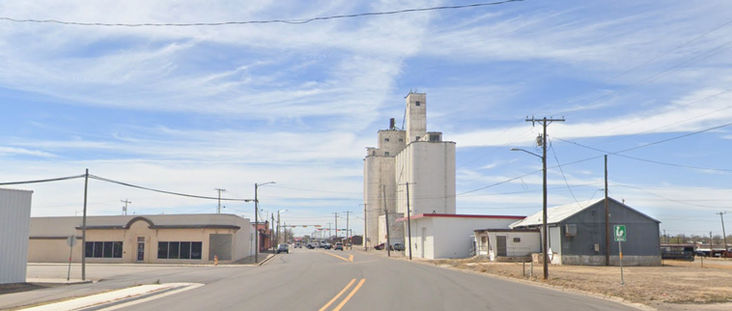
On March 28, 1987, Melvin K. Drum was the Chief Deputy Sheriff of Ochiltree County, Texas. Several calls were made to Drum's residence that day concerning a domestic dispute between Alvin Wayne Crane and his wife, Linda Crane. In addition, there were threatening calls made by Crane to the home of Mr. Gayle Rogers, the business manager of Mrs. Crane's boss.1
Mrs. Crane was employed as a practical nurse at the home of Mrs. Spicer, an elderly invalid. Crane went to the Spicer home earlier in the day and argued with his wife. Crane smashed the windows of his wife's car with a shovel as she sat in the car and the police were called for the third time that day.
Crane departed before the arrival of the police. Later, Crane called Mr. Rogers' home, demanding his wife's check, although it was not yet due to be issued. Melvin Drum and his son, Delvin Drum, an Ochiltree deputy sheriff, after hearing about Crane's activities, left the Drum residence to investigate. The officers departed in separate vehicles. Melvin Drum drove an unmarked vehicle.
Sherry Vance lived across the street from the Spicer residence. On the day of March 28, at 1:25 p.m., she heard the short beep of a siren. She went to the window and observed a green car pull into the Spicer driveway. Then she saw a red car driven by Melvin Drum pull in near the Spicer home.
Ms. Vance saw the Crane's wife approach Melvin Drum's car. Vance then saw Crane with a shotgun. Crane pointed the shotgun at Drum. His wife grabbed him, shook him, and told him, "No."
She then went back toward the Spicer residence. Crane then shot Melvin Drum who was seated in his car. Vance saw the impact of the shot on Melvin Drum's body. Crane then fled the scene.
Bruce Evans, an Ochiltree County deputy, testified that when he arrived the red "kojak" light on the dashboard was still flashing.
Delvin Drum testified that when he arrived, his father was slumped over in the car. Melvin's badge was plainly visible and was wearing a holstered service revolver.
Officer Roberts, arrived at the murder scene within minutes of it happening. He was told by Crane's wife that her husband had just shot Melvin Drum. With this information, Officer Roberts requested the police broadcast for Crane's arrest.
Arrest

Based on a police broadcast, Crane was arrested by Oklahoma authorities two and a half hours later at a roadblock in Beaver County, Oklahoma for the murder of Melvin Drum. He had led Oklahoma Highway Patrol on a high speed chase before his apprehension.
He fought extradition and staged a nine-day hunger strike but was returned to Texas on April 15, 1987.2
Melvin Drum
Drum was the first Ochiltree County deputy to die in the line of duty. He was a father of 2 and also had 2 grandchildren. He was on the force for 7 years at the time of his death.
Trial
The trial was held in Denton county on a change of venue from Ochiltree County.
Guilt/Innocence phase
Crane's trial counsel, Gene Storrs and Stephen Cross, investigated a possible insanity defense for Crane. In the end, they rejected it as a defense because it was not a viable one.
Crane's counsel then investigated whether Crane's injuries from a motorcycle accident in 1981 could have resulted in some mental impairment that interfered with Crane's abilities to act intentionally and rationally.3
They arranged for Dr. Michael Buben to examine Crane while he was incarcerated in Ochiltree County. The resulting report stated that Crane suffered from persistent, recurrent headaches over the right frontal region.
Counsel then consulted Dr. Joseph Batson, a neurologist, who examined Crane in September 1987. Dr. Batson ordered a CT scan and an EEG, both of which failed to show any abnormality. As a result, Crane's counsel decided to introduce these medical records to the jury, but would not further develop an insanity defense.
Punishment phase
Robert Goetzinger, an assistant district attorney from Beaver County, Oklahoma, testified that he prosecuted Crane for felony offenses of unlawful delivery of marihuana and unlawful possession of marihuana with the intent to distribute.1
The marijuana charges stemmed from when police made an undercover drug buy at his home. At the time they arrested him, they seized an illegal machine gun and illegal sawed off shotgun from his home.
Crane was convicted and assessed two five-year suspended sentences. Among the conditions of his probation was that he could not leave the state of Oklahoma and that he could not own or have in his possession or control any weapon or firearm for any purpose.3
Two months before the shooting of Drum, Goetzinger prosecuted Crane on two new misdemeanor assault charges he was arrested for. Crane had assaulted his children's bus driver for running over his dog. He pursued the bus driver at high-speed to the school, in an attempt to continue beating him. (The bus driver had returned in a car to remove the dog from the road).
Crane pled guilty, but Goetzinger testified that he warned Crane that any future violations would result in revocation.
The bus driver in question who Crane assaulted also testified at the punishment phase. According to the driver, Crane chased him at speeds up to and over 100 m.p.h3
Crane offered no evidence at the punishment phase.
November 13, 1987
A Denton County jury convicted Crane of Capital Murder and sentenced 27-year-old Crane to death.
The day of the sentencing, sheriff's deputies lined the hallways and snipers lined the rooftops due to threatening phone calls regarding a possible escape attempt by Crane.
The jurors received an armed escort from the building following the trial.4
Appeal
Crane argued that the trial court erred in admitting into evidence items seized from his automobile and his person as a result of an illegal arrest. Crane argued that his arrest in Oklahoma by an Oklahoma sheriff and an Oklahoma state trooper, pursuant to a Texas police radio broadcast, was not a valid warrantless arrest under Texas law
In a habeus, Crane alleged his trial counsel was ineffective because they did not pursue an insanity defense. On the contrary, the medical reports from Dr. Buben and Dr. Batson suggested that even if Crane had some dysfunction due to his motorcycle accident, this dysfunction did not rise to the level of interfering with his abilities to act intentionally and deliberately.
Trial counsel also stated that they were concerned about opening the door to damaging testimony concerning Crane's violent tendencies if the issue of insanity were raised.
Execution Day
Crane was executed on October 12, 1999. He was 41 years old.
Crane gave a lengthy statement in which he expressed love for his family and apologized profusely.
"I have caused you a lot of pain and suffering. I hope you find some peace and comfort in this. If you have any anger, I hope you let it go. I'm sorry for causing everybody so much trouble."5
 10-13-1999
As the drugs began taking effect, several of Crane's family members sobbed as they watched through a window. He smiled, nodded to them and said, "Everything's going to be just fine. I love you all."
The needle inserted in Crane's right arm was a few inches above a tattoo of a skull. Once the drugs began taking effect, he turned purple. He let out a long gasp, then 2 short gasps before slipping into unconsciousness.
Alvin Wayne Crane was pronounced dead at 6:23 p.m., 9 minutes after the flow of lethal drugs began.
 TDCJ Intake form for Alvin Wayne Crane
Resources
Footnotes
-
No. 69977., Alvin Wayne CRANE v. The STATE of Texas, Court of Criminal Appeals, En banc, January 31, 1990. ↩ ↩2
-
https://www.upi.com/Archives/1999/10/12/UPI-Focus-Killer-of-Texas-deputy-sheriff-executed/1136939700800/ ↩
-
United States Court of Appeals for the Fifth Circuit 178 F.3d 304 Alvin Wayne CRANE v. Gary L. JOHNSON, Director, June 8, 1999 ↩ ↩2 ↩3
-
"Man sentenced to death in shotgun slaying of deputy," The Courier-Gazette, published November 13, 1987 ↩
-
https://www.tdcj.texas.gov/death_row/dr_info/cranealvinlast.html ↩