The Death of Gail Lenore Smith
On October 14, 1985, at about 4:00 p.m., John and Milagros Wertz drove John's step-sister, Gail Lenore Smith, to a rest stop outside of Fort Worth, Texas. Gail needed to visit her mother in Lake Meredith. Her plan was to catch a ride with a trucker headed through there.
John and Milagros watched as Gail got out of their car and approached a man with a thin build and sandy brown hair. Soon after, the man and Gail entered his cherry red Peterbilt tractor-trailer.
As Gail had discussed with the couple before heading to the rest stop, they tried to write down the license plate number--but were unsuccessful. However, the two were able to memorize the details of the Peterbilt, including the company name inscribed on the cab doors: "JEWETT SCOTT Truck Line, Inc. Magnum Oklahoma"
It would be the very next day, on October 15, 1985, that a truck driver named Donald Ray McKay found the naked body of Gail Lenore Smith in a brushy area 1.5 miles north of the Canadian River Bridge on Highway 287.
 US 87
McKay had stopped to answer nature's call and found the woman's naked, lifeless body bound in silver duct tape hidden in the brush. The woman had been badly beaten about the head and had a man's tie knotted tight around her throat.
A fingerprint comparison identified the victim as Gail Smith.
Once Smith's body was found and law enforcement contacted the Wertezes to inform them of Gail's demise, the couple was able to give them detailed description of the cherry red Peterbilt, which would prove to be invaluable.
Investigation
its trailer bore the legend "Ruger Freight." Detectives traced the Jewett Scott Trucking Line firm to Mangum, Oklahoma. An examination by the company of the schedules on file revealed that Herbert Boyle had been the only driver in the area. Per the company, they were able to pinpoint the next destination of the truck as in Diboll, Texas.
The race to Diboll, Texas
At the time of learning about his arrival in Diboll on October 17, 1985, the police lacked sufficient probable cause for a search warrant as well as an arrest warrant for Boyle. In a workaround, Sgt. Walter Yerger of APD was able to secure a grand jury material witness attachment for Boyle signed by a district judge on October 17, 1985.
Simultaneously, a representative of the Potter County Sheriff's Department was sent to Mangum, Oklahoma. By 8:30 p.m. that evening, the representative obtained from Jewett Scott, the owner of the truck line, a written consent to search the truck which the Boyle was operating.
Knowing that Boyle would be arriving in Diboll, Texas, a teletype was sent to the Diboll Police Department with instructions to arrest Boyle and secure the truck until law enforcement from Amarillo could get there, grand jury material witness attachment in hand.
The the group that traveled to Diboll consisted of Sgt. Walter Yerger, Corporal Joe Allen, and Modeina Holmes of Amarillo Police Department; James Farren of the Potter County District Attorney's Office, and Texas Ranger Ronnie Griffin.
The group left Amarillo at 9:00 p.m. on October 17, 1985 and arrived in Diboll at 7:00 a.m. on October 18, 1985.
Arrest, interrogation, and statement
In the early evening hours of October 17, Boyle was arrested at a Diboll convenience store. The truck was secured and held at the location where the arrest occurred.
On October 18, 1985, the following events took place:
7:00 a.m. As soon as the group from Amarillo reached Diboll, Sgt. Yerger conducted a 30 to 45-minute long interview with Boyle. Before the interview (considered a custodial interrogation), Boyle signed a form that showed he was read his Miranda warnings.
7:15 a.m Boyle signed a consent form for law enforcement to search his truck
8:33 a.m. After the interview, Sgt. Yerger took Boyle to be arraigned as a material witness by a local justice of the peace at 8:33 a.m. Afterwards, Boyle was taken straight back to the jail and Mirandized again by Sgt. Yerger.
8:45 a.m. Detective Holmes and Corporal Allen began a thorough and complete investigatory search of the cab and sleeper area of Boyle's Peterbilt.
They concluded their search at 6:00 p.m.
5:24 p.m. An arrest warrant for capital murder was issued out of Amarillo and sent via teletype to Diboll Police.
7:45 p.m. Sgt. Yerger received the teletype that an arrest warrant had been issued at 5:24 p.m. for Boyle for the offense of capital murder in Amarillo.
Affidavit for arrest warrant of Benjamin Herbert Boyle
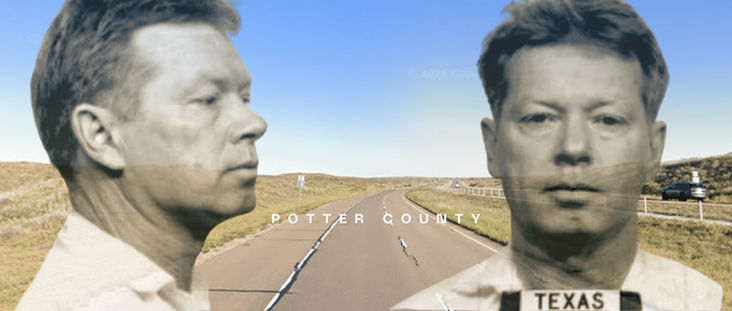
 Herbert Benjamin Boyle
The affidavit, executed by Sgt. Yerger on October 18, 1985, read as follows:
That on October 15, 1985, Donald Ray McKay [sic] a truck driver [sic] reported to Potter County Sheriffs Office that he had spotted a naked body at approximately 5:00 p.m. located approximately lA mile north of the Canadian River Bridge on Highway 287 and approximately 14 miles north of Amarillo, Potter County, Texas. Officers responding to the location located the body, later identified as Gail Lenore Smith by a family member.
Affiant in tracing the whereabouts of Gail Smith, on the day before, learned that Gail Smith left Fort Worth, Texas, on October 14, 1985, at approximately 4:00 to 4:30 p.m.
Affiant learned that before Gail Smith left Fort Worth she was taken outside the city limits by Gail Smith's sister, Margie Smith, so that Gail Smith could hitch a ride.
Margie Smith saw Gail Smith approach a truck driver approximately 7 miles outside of Fort Worth on Route 287. However, before Gail Smith entered the truck she advised her sister, Margie Smith, to record the tag number of the truck. Margie Smith did not at that time write [sic] the tag number of the truck but did get a good look at it and described it to Curt Brenner of the Fort Worth Police Department, [sic] as having the company name of Jewett Scott Trucking Company. She further described it as a Peterbilt brand semi-tractor truck, cherry red in color with a sleeper cab.
Margie Smith gave the foregoing description of the truck to the Fort Worth Police Department after being informed that her sister's body had been discovered by law enforcement officers in Amarillo.
Based on the description that Margie Smith gave of the truck, Affiant learned that this company was located in Magnum, Oklahoma. An officer of that company by the name of Steve Scott indicated to the law enforcement officers that the only truck Jewett Scott Trucking Company had in the Fort Worth area on the 14th of October was one driven by Benjamin Herbert Boyle.
Steve Scott advised the Affiant that the truck in question was assigned to Benjamin Herbert Boyle and that Benjamin Herbert Boyle was an employee of Jewett Scott Trucking Company. Steve Scott also described the truck as having a red or burgundy cloth interior in the sleeping cab of the semi-tractor truck, and is the only truck that Jewett Scott Trucking Company owns with that type of sleeper interior.
Affiant has learned from Modeina Holmes, an I.D. Technician for the Special Crimes Unit of the Amarillo Police Department that investigates homicides that the naked body of Gail Smith was covered with red type fibers.
Affiant also learned from Steve Scott that Benjamin Herbert Boyle was to go to Canon City, Colorado, after leaving Fort Worth and go through Amarillo, Texas.
Affiant knows from personal experience and from studying a Texas roadmap that a common and convenient route to Canon City from Amarillo would be to go through Dumas, Texas, located on Route 287. The body was discovered between Amarillo and Dumas on the route that Benjamin Herbert Boyle would more than likely have taken.
Affiant has also learned that Margie Smith described Benjamin Herbert Boyle as being a white male who was tall, thin, with brown to reddish brown hair, medium to short length, wearing a western dress type shirt.
Affiant has also learned from Steve Scott that Benjamin Herbert Boyle, in fact, matches this same description.
Affiant has learned from Dr. Ralph Erdmann, a forensic pathologist, that the death of Gail Smith occurred sometime between 1:00 and 5:00 a.m. on October 15, 1985, approximately 8 to 12 hours after Gail Lenore Smith was last seen alive in Forth [sic] Worth, Texas.
Statement of Herbert Benjamin Boyle
Boyle readily identified a snapshot of the victim, claiming he had dropped her off, alive, in Wichita Falls, near the Texas-Oklahoma border. Boyle was transported to Amarillo and gave a statement denying his guilt on the 19th of October as well as giving his consent to the police obtaining hair and blood samples.[^4]
The written statement taken on October 19, 1985 at 10:05 p.m., excluding the formal portions, reads as follows:
My name is Benjamin Herbert Boyle. I am 42 years old. My date of birth is 7/22/43. I was born in Hobart, Oklahoma. I live at 401 South Main, Canute, Oklahoma. My home phone number is 405/472/3842. I work for Jewett-Scott Trucking Company.
On Monday, October 14, 1985, I was sitting in my truck on US-287 near the Hammon Road Exit when a girl came up to my truck and ask me if I was going to Amarillo. I told her yeah, I was going to towards [sic] Amarillo. I told her I would give her a ride.
Sgt. Yerger showed me a photograph and told me the photograph was of Gayle [sic] Smith. The girl in the photograph is the same girl I picked up.
While riding in my truck, the girl set her purse in the boot of the sleeper and it fell out. I later found a lighter, a pack of cigarettes, and a make-up brush in my truck. I put all these items in a catch-all thing on the dashboard. I let Gayle [sic] out at the Jolly Truck Stop south of Wichita Falls, Texas, about 7:00 or so on Monday night. I never saw her again. I never had sex with the girl.
Evidence against Boyle
Some of the evidence against Boyle included:
Inside the truck
- Inside the truck, officers found several of Smith's possessions.
- Hairs from Smith's head and pubic area, some of which had been forcibly removed.
- Sheets and blankets that had fibers taken from them and sent to Washington, D.C. for FBi analysis
- blood stains in the sleeper portion of the truck were consistent with Smith's blood type
- Boyle's fingerprints were found on the strips of duct tape used to bind Smith
- fibers taken from Smith's body matched the carpet in Boyle's truck
- Boyle's wife recalled that she had seen some bloody sheets inside the truck, a short time earlier.
Medical evidence
- Medical evidence showed that Smith had been orally and anally raped, beaten with a blunt instrument, and strangled to death.
Trial
Boyle's capital murder trial took place in 320th Disttrict Court in Potter County.
Pre-trial hearing, motion to suppress
A pretrial hearing was held on the motions, and the State, in its brief on motion for rehearing, has directed us to testimony in the record of the pretrial hearing and the trial which supports the validity of the third party consent.
Deputy Dennis Horn testified at the pretrial hearing that on October 17, 1985, he visited with Jewett Scott, the owner of the trucking company, and obtained his voluntary consent to search the truck Boyle was driving. Scott told Horn he was the owner of all the trucks that the company operated. The consent form was admitted into evidence at the hearing and also later at trial.
Jewett Scott testified at trial that the truck Boyle was driving was the property of "our corporation."
Stephen Scott, Jewett's son, also testified at trial that Boyle was assigned to "our tractor No. 52" when he (Boyle) was an employee of the company in September/October 1985.
Exhibits
Exhibits admitted at trial included:
- State's Exhibit No. 13 - a fiber taken from the cab portion of the tractor and was identical to a fiber found on the duct tape that bound the victim, per expert testimony.
- State's Exhibit No. 15A - a fiber taken from the cab portion of the tractor and matching a fiber found on the deceased's back.
- State's Exhibit No. 13 - also found to match State's Exhibit No. 16A, which is a fiber found in the crotch and rectal area of the deceased;
- State's Exhibit No. 17A - a fiber found on the back of the deceased; State's Exhibit No. 18A, a fiber found on the back of the deceased
- State's Exhibit No. 21A - a fiber taken off the duct tape which bound the feet of the deceased
- State's Exhibit No. 22A - a fiber retrieved from the duct tape that bound the deceased;
- State's Exhibit No. 2 - debris found on the duct tape which bound the deceased.
- State's Exhibit No. 5A - a dark brown Caucasian head hair recovered from the sleeper portion of the tractor and determined to have been forcibly removed and matched the head hair of the deceased.
- State's Exhibit No. 93A - a hair found on a paper towel and napkin under the driver's seat of the vehicle and subsequently determined to be a forcibly removed dark brown pubic hair microscopically matching the pubic hairs of the deceased.
- State's Exhibit No. 73A - a hair found on the floor mat of the cab portion of the tractor and found to match the head hair of the deceased.
- State's Exhibit No. 75A - sun glasses found in the cab portion of the tractor which also had on them a dark brown head hair which had been forcibly removed and matched the head hair of the deceased.
- State's Exhibit No. 52A - paper towels found on the floor of the cab portion of the tractor containing head hairs which matched the hair of the deceased.
- State's Exhibit No. 76A - a hair found in the cab portion of the tractor and found to match the head hair of the deceased.
- State's Exhibit No. 34A - a maroon pouch found on the floor of the cab portion of the tractor which contained hair matching the head hair of the deceased.
- State's Exhibit No. 69A - a gray Tshirt found in the sleeper portion of the tractor wherein a hair was retrieved which was determined to match the head hair of the deceased.
- State's Exhibit No. 13A - a hair found on a yellow afghan in the sleeper and determined to match the head hair of the deceased.
- State's Exhibit No. 62A - a hair recovered from a quilt which was in the sleeper, which matches both the pubic and head hair of the deceased.
- State's Exhibit No. 79A - vacuum sweepings from the mattress in the sleeper, and contained head hair matching that of the deceased.
- State's Exhibit No. 88A - a hair found on the Marlboro cigarette carton which was on the dashboard of the tractor, and matched the head hairs of the deceased.
- State's Exhibits Nos. 20, 54, 86, 10, 69, 83, and 7, were all scrapings of blood, which were consistent with that of the deceased. These scrapings were recovered from various items found in the cab portion of the tractor.
- State's Exhibit No. 65 - a napkin identified as coming from the tractor and containing blood on it, the typing consistent with that of the deceased.
- State's Exhibit No. 29 - the appellant's shaving kit determined to contain traces of human blood consistent with the deceased.
- State's Exhibit No. 13 - was a yellow afghan taken from the sleeper portion of the tractor which contained the presence of blood consistent with the blood of the deceased.
- State's Exhibit No. 91 - material identified as coming from the mattress in the sleeper containing blood spots which were determined to be consistent with that of the deceased.
- State's Exhibit No. 82 - a jacket found in the cab portion of the tractor and containing blood stains determined to be consistent with the blood type of the deceased.
- State's Exhibit No. 19 - a swabbing extracted from the sleeper storage compartment which was determined to be human blood matching the blood type of the deceased.
- State's Exhibit No. 92 - eight tie down cords, all recovered from the cab portion of the tractor, containing human blood stains, all consistent with the blood type of the deceased.
- State's Exhibit No. 94 - a pill box from which blood scrapings were recovered and determined to be consistent with the blood type of the deceased.
- Also recovered from the cab portion of the tractor and introduced into evidence were personal items which were identified as belonging to the deceased.
- State's Exhibit No. 10 - is a tire billy found in the cab which the State argued was used to assault the deceased.
Guilt/Innocence phase
Boyle went to trial for Gail Smith's murder in October 1986.
Dr Ralph Erdmann testified he could not give an opinion as to whether the deceased had been sexually assaulted because he did not take any smears from her mouth.
An FBI serologist testified he conducted tests to identify blood and semen from the deceased's vagina and thigh, and neither was identified.
The serologist also conducted tests on swabs taken from the victim's mouth, and he identified semen on them. However, the serologist could not testify the semen came from Boyle, nor was he qualified to testify whether the semen was there as a result of consensual sex or a sexual assault.
Margaret Rose Smith, the victim's sister was called by the defense to testify at trial. Out of the jury's presence, defense counsel questioned Smith about entries in her sister's diary which discussed several male companions and sexual contact with them. One specific entry stated she had sex several times during August and September of 1985 with a former boyfriend. Defense counsel asked Smith about six other men mentioned in the diary. Finally, defense counsel asked Smith if her sister, the victim, "ever engaged voluntarily or consentually (sic) in oral sex with any of these individuals or with any other individuals", to which Smith answered she did not know.
The State objected to the admission of this evidence on the ground the defense had shown "absolutely no relevance." The trial judge sustained the State's objection.
Verdict
It took a jury three short hours to convict him on October 29.
Sentencing phase
At the trial, prosecutors tried to tie him to the slaying of a woman in California, but the evidence was disallowed. The woman's decomposed body was found in a cardboard box near a campsite just off California Highway 267.
Evidence put on by the State at the sentencing phases promoted that Boyle was obsessed with sex and that he associated sex with violence, which ultimately resulted in a sexually motivated murder.
Exhibits concerning this included three letters and brief testimony concerning Boyle's preoccupation with sex. The State then put on additional testimony about Boyle's sexual habits and evidence concerning his sexual drawings.
Elneta Boyle, Boyle's wife, was called to testify in its behalf at both stages of this trial. She testified that Boyle had beaten her several times and once threw a butcher knife at her for failing to put mayonnaise on both sides of his sandwich.
Detective William Faulkenberry of the Colorado Springs Police Department testified at the punishment phase of the trial that he had in his possession he had a criminal record file of Boyle which consisted of three white cards with the inked fingerprint impressions of Boyle stemming from a previous conviction in El Paso County, Colorado.
Pat Willis testified that she had had an affair with Boyle. Boyle had apparently lied to her about his marital status in order to begin the affair. She further testified that Boyle wrote her sexually explicit letters referring to her genitalia as "Miss Kitty" and to his own as "Mr. Whipple."
Three letters entered as evidence contained statements such as,
"I would unleash Mr. Whipple on you. Ha! Ha! I know you can handle him. He knows it too. At this very moment, I believe he knows I'm talking about him. He seems to be stirring. Oh, mama, do I need you."
One letter states,
"Miss Kitty is in some real trouble now. I may not be able to tear her up, but she will know Mr. Whipple has been there."
Connie Smith, Boyle's daughter, testified that he was a "womanizer" and drew and kept many sexually explicit pictures. She testified that Boyle had beaten her mother several times and once threatened her mother with a gun over the past several years. She told the jury that she was a fraid of her father.
Norma Myers testified that she was a former lover of Boyle and confirmed that he had a strong preference for oral and anal sex. He often put pressure on her to perform the acts and that sometimes he held her down and pretended to choke her during foreplay.
A former cellmate testified that Boyle associated sex with violence. He recalled a time that another inmate mentioned having trouble with women and Boyle's remark was that "if it was me, I'd slap her, throw her down on the floor and fuck her in the ass."
The verdict
The jury took 25 minutes to decide his punishment.
The sentence: Death.
Post-trial accusation
After his Amarillo conviction, Boyle was named in warrants issued out of Missouri after a lengthy investigation into the rape and stabbing of a 19-year-old St. Louis woman.
According to St. Louis police, the victim was taken to an isolated area where she was sexually assaulted and stabbed at least twice. In 1987, the victim traveled to Huntsville and identified Boyle as her attacker, authorities said.
Appeal
A May 15, 1991 memorandum opinion published by the Court of Criminal Appeals reversed and remanded the case to trial court. However, the State filed an en banc rehearing in which the court reversed its ruling, holding that Jewett Scott's consent to search the truck was constitutionally adequate.
In particular, the initial ruling attacked the legality of the evidence seized by law enforcement when they went to arrest Boyle in Diboll, Texas.
Their reasoning was rooted in the admissions of Sgt. Yerger that he did not have enough probable cause for a search or an arrest warrant for Boyle when he made the trip there. Additionally, they embarked on the journey to Diboll with the intent of taking a homicide suspect into custody, rather than the grand jury material witness attachment they represented to the district court.
....the nature of the crime, no matter how senseless or heinous, is not the criteria. Law enforcement officers are not free to choose under what circumstances they will remain true to the mandates of the Federal and State Constitutions. The State has utterly failed to establish beyond a reasonable doubt that this error of constitutional magnitude was harmless.
In the en banc rehearing, they re-evaluated the testimony at a pretrial hearing given by the owner of Jewett Trucking and his son that showed the truck Boyle drove was theirs to give consent to search.
Boyle vs Johnson
This federal level habeas relief filed in 1996 argued that the trial court erred in allowing evidence of his sexual habits and drawings. This was the cornerstone of their argument that Boyle would be future danger to society.
The testimony of Ralph Erdmann was also called into question. At the time of the appeal, Erdmann's misconduct and handling of other cases was in the process of unfolding. Boyle argued that the prosecutor knew of Erdmann's misconduct and failed to disclose it. But the court found that Boyle had not presented proof that Erdmann mishandled the autopsy in Boyle's crime.
Ineffective assistance of counsel
He also argued ineffective assistance of counsel, claiming that key mitigating evidence was not admitted into the punishment phase. The court overruled this argument.
At Boyle's writ hearing, his trial counsel testified that he did not introduce certain evidence concerning Boyle's background and character for tactical reasons.
As to the evidence of Boyle's violent family background, trial counsel responded, "It would have been aggravating."
As counsel put it, "We were trying to keep as much violence as we possibly could out of the record."
Counsel was concerned that evidence of his abusive father would cause the jury to think, "like father, like son."
As to the evidence of drug and alcohol abuse, counsel stated, "It would have been aggravating." Counsel continued, "I did not think it was beneficial, particularly in 1986 to tell this jury that he was a pill popping ... truck driver."
Counsel also made strategic decisions not to put into evidence Boyle's non-sexual drawings, and the testimony of other women with whom Boyle had had sexual relations.\
In essence, all the evidence that Boyle maintains should have been presented at the punishment phase of his capital murder trial had a double-edged quality.
Failing to introduce evidence of a mental illness as mitigating factor
The defense was concerned that if they put on such psychiatric evidence to a potential mental illness, the state would put on its own psychiatrist to testify as to Boyle's violent tendencies
Boyle's counsel testified:
"Well, because Mr. Boyle, while being a rather articulate artist, there were two types of art that he delved in. He had the capability of drawing a small kitten that looked so soft you would want to pick it up and pet it.... He also had the ability to draw masochistic sadistic cult type art depicting women in bondage under the throes of demonic type men. And I don't think that that was the type of art that was conducive to convincing a jury not to kill him."
Failing to introduce evidence of Boyle's good nature as mitigating factor
Boyle's counsel testified that all the women who were willing to testify as to Boyle's good nature were women with whom he was having adulterous relations. As Boyle's counsel put it:
"If I put in about alcohol and his womanizing and his running around on his wife and his running around on his girlfriends, that is not going to be a mitigating factor in Amarillo, Texas."
Mitigation problems
As Boyle's counsel testified
"Well, every family member I talked to was a possible mitigation witness. Every girlfriend I talked to was a possible mitigation witness. But every time I talked to some of these people, the I--there were other problems associated with it."
"That's why we didn't talk about his use of amphetamines while driving a truck. That's why we didn't talk about his alcoholism. That's why we didn't talk about the child abuse. That's why we damn sure didn't talk about his sex life."
Execution
Boyle was executed on April 21, 1997. He was 53 years old at the time of his execution.
His last meal was a double-meat cheeseburger, french fries with ketchup and a Coke.
When asked if he had any final words, Boyle shook his head 'no'. He kept his eyes closed and made no contact with his victim’s mother and sister, who watched through a window.
The drugs were administered at 6:14 p.m. Boyle gasped a couple of times and sighed deeply before he stopped breathing.
He was pronounced dead at 6:21 p.m., seven minutes after receiving a lethal dose of drugs.
Joyce Smith, the victim’s mother, said the execution brought her some closure.
"It’s not the end because you never stop grieving for a child but it does have a final ring to it,″ Ms. Smith said. "I want to know he won’t harm another woman’s daughter."
No family members attended Boyle's execution.
Sources
-
Boyle v. State 820 S.W.2d 122 (1989), Court of Criminal Appeals of Texas, En Banc, Rehearing June 27, 1990
-
Herbert Boyle vs Johnson, TDCJ, U.S. Court of Appeals, Fifth Circuit Aug. 16, 1996
-
MICHAEL GRACZYK, Trucker Executed for 1985 Murder
-
Michael Newton - An Encyclopedia of Modern Serial Killers - Hunting Humans
-
findagrave.com, Elneta Fay Boyle