If it had not been for his tattoos, Kevin Parks (not his real name) would have been forever branded as a killer.
One of Amarillo's oldest cold cases is one that's locked up tight and rarely brought out into the light.
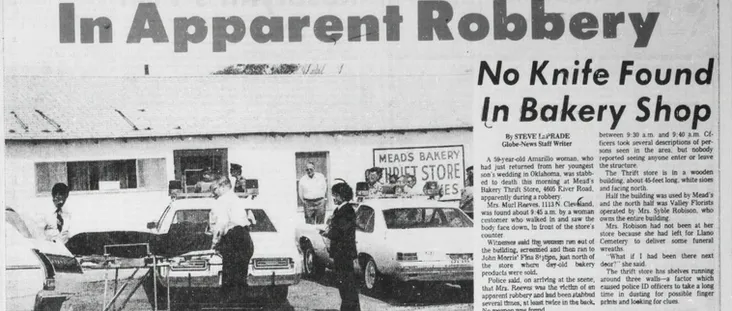
Murl Reeves managed the Mead's Bakery Thrift Store at 4601 River Road. The 59-year-old woman was found stabbed to death on the morning of May 31, 1977.
There is a narrow window for Murl Reeves' death. News coverage from 1977 puts that window at between 9:30 a.m. and 9:45 a.m.
The last person to see her alive was the bakery salesman who delivered bread and cash to the store around 9:30 a.m.
The person to see her deceased was a regular customer who found Reeves face-first in a pool of blood in front of the counter at around 9:45 a.m. The cash-register drawer was ajar.
An autopsy later showed that Murl was stabbed seven times, with two strikes to the back and a fatal strike to her chest.
A 2011 revisit of Murl Reeves' death by the Amarillo Globe News tells readers that investigators canvassed the River Road neighborhood and developed a description of the suspect: 5 feet 9 inches with curly light brown hair or dark blond hair that grew past the ear; late teens.
But in the newspaper archives of 1977, police discuss the various descriptions given to them of people seen near the bakery shop.
"We have at least three different descriptions, and we're looking at them all," said Capt E.N. Smith.
One description was of a black man in his late 20s or early 30s, roughly six feet and about 130 pounds. A second description was for a 21-year-old man who lived on Cottonwood near the store. A third description fit a 24-year-old hitchhiker from California who was seen near the store.
The day of the killing, police arrested the hitchhiker near Amarillo Boulevard and Buchanan Street. They kept him overnight for questioning but released him the next day.
A black man originally sought for questioning was found to have no involvement in Murl Reeves death.
But 21-year-old Kevin Parks who lived near the store learned that police were looking to question him about Murl's death and went down to the police station himself to present himself.
Police leveraged an open theft warrant to keep Parks in custody. By June 9, 1977 they told area news outlets that Parks was a "good" suspect for the death of Reeves. Police also said that they sent several items of evidence to a lab in Dallas for blood testing.
Parks was charged with capital murder on June 17. He was denied bond.
In the 2011 revisit of Murl Reeves' death by the Amarillo Globe News, the lead investigator of the Special Crimes Unit briefly mentions that police had arrested a suspect, but lack of evidence brought the prosecution to a grinding halt.
News coverage from 1977 shows that a preliminary examination hearing was held for Parks in the second week of July. Two eyewitnesses who identified Parks at the police station as a man they saw near the bread store were called to testify.
The first eyewitness was a 17-year-old deliveryman working across the street from the bakery store. He had seen a man walking near the bakery store at about the same time the customer discovered the body of Murl Reeves. That man had been wearing a green shirt with short sleeves he said.
He went on to indicate that his identification of Parks came after feeling pressure from police to pick him out of a line up after failing to ID him at first.
Parks' attorney, Selden Hale, then had his client unbutton his white coveralls issued by the jail so that the distinctive tattoos on his upper arm and forearms could be seen.
"The guy I seen didn't have tattoos," exclaimed the 17-year-old eyewitness.
"Then this is not the man, is it?" asked Hale.
The eyewitness shook his head.
The second eyewitness was the operator of the same store the first eyewitness worked at across the street from the bakery. He testified that he saw a man in the doorway of his shop the same morning Murl Reeves was found dead.
That man, he said, was wearing a maroon shirt that had either short sleeves or rolled cuffs. However, he had failed to pick him out of a police lineup twice.
Hale hadParks once again unbutton his coveralls to show the eyewitness.
"I didn't notice those tattoos," the second eyewitness conceded. But he maintained that he was sure it was Parks because of his hairstyle.
Apart from the eyewitnesses from across the street, there was also problem with a key piece of evidence: the pants.
Pants that belonged to Parks were sent to a Dallas laboratory for testing. They were sent with the lead homicide investigator's knowledge.
Then there were the pants taken from the California hitchhiker who had been taken into custody the day of the murder, then released. Those blood-stained pants were also sent to the lab in Dallas for testing--which the lead investigator was not aware of.
The jeans owned by Parks had no bloodstains for the lab to test, said the report from Dallas. The jeans owned by the California hitchhiker who was released from custody were a "very good match" to the blood of Murl Reeves.
But because the lead investigator only knew of Parks' pants being sent to the Dallas lab, he assumed those were the pants that matched the lab results that showed a good match. And those were the results he presented to the District Attorney to charge Parks with capital murder.
When presented with the two sets of pants and lab results showing which pants belonged with whom, the lead investigator acknowledged the communication mix-up but asserted that "[the police] still have probable cause" for Parks as a suspect.
However, in an uncommon display of agreement, the defense attorney, district attorney and several witnesses all agreed that there was not enough evidence to hold Parks any longer on the capital murder charge.
"The cops made a mistake," said Hale.
The judge agreed. The murder charge against Parks was dismissed on July 14, 1977.
In the Globe-News 2011 revisit of the cold case, the Lieutenant interviewed said that "Investigators had two people of interest and within five years, obtained DNA from one of the men."
It's uncertain if the Lieutenant was referring to Parks or hitchhiker who slipped away. Nevertheless, the Lieutenant lamented that the crime was so old he didn't know if there was DNA evidence collected at the scene that could be used for testing.
In one haunting Globe-News article dated June 2, 1977, the discovery of a bloody shirt in a Goodwill Store on East Amarillo Boulevard is documented.
"It didn't have our marks on it," executive director Marilyn Williams told the Globe-News. "So it didn't come from one of our collection boxes. It looks like someone came in and slipped it on a hanger"
She told the Globe-News that police came and collected the shirt, then showed the workers mug shots to see if they recognized a suspect who was by then in jail--presumably Parks.
On a map, the bakery, Goodwill store, and the intersection where police arrested the hitchhiker suggest a path of someone who came off the highway to the bakery shop, then took flight in the opposite direction and was circling back to head west--possibly towards California.
The knife used as the murder weapon has never been never found.
In the 50 years since the violent, unresolved death of Murl Reeves and Kevin Parks' narrow brush with wrongful conviction, the cold case has languished. But yet, in some ways, it remains as relevant as ever.